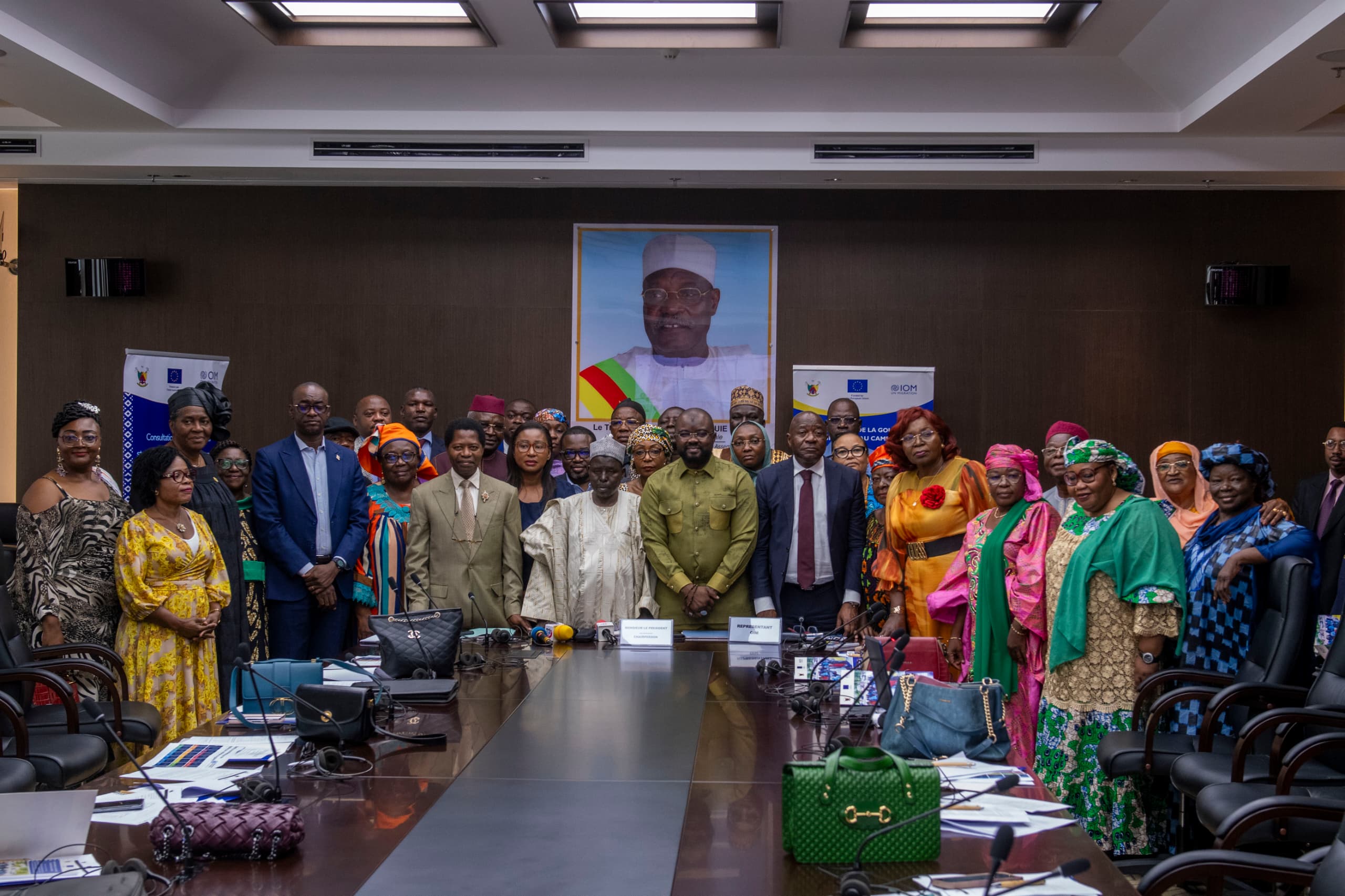
On April 9, 2026, the National Assembly’s Cavaye Yeguie Djibril commission room hosted a high-level consultation bringing together parliamentarians, senators, and the Ministry of External Relations – MINREX to shape the future of Cameroon’s migration landscape.
Organized by the International Organization for Migration – IOM, the meeting focused on the dual objectives of developing a comprehensive National Migration Policy and reviewing the implementation of the Global Compact for safe, orderly, and regular migration.
Under the leadership of Honorable Zondol Hersesse, President of the Constitutional Law Commission, the session served as a strategic platform to align national legislative efforts with the reality of Cameroon as a pivotal country of origin, transit, and destination.
Abdel Rahmane Diop, IOM Chief of Mission, opened the dialogue by emphasizing the undeniable urgency of migration governance. Highlighting the tragic human cost of irregular migration—where thousands of Cameroonians have faced peril in deserts and seas—Diop noted that approximately six to seven people left the country irregularly every single day over the last four years.
He underscored that migration must be viewed as a lever for development rather than a crisis. To achieve this, he called upon the lawmakers to ensure that national laws regarding remittances, entry, and stay are coherent with a “paramount vision” of growth, especially as international funding face significant cuts, making national ownership and budgetary support more critical than ever.
Echoing this sentiment, Honorable Zondol Hersesse stressed that migration governance cannot be a centralized, top-down affair but must be “locally entrenched.” As the direct link between the state and the people, parliamentarians are tasked with translating field realities—such as youth employment, social cohesion, and the resilience of households in fragile zones—into robust legislative action.
Hersesse argued that for the upcoming 2026 referendum and future policies to be efficient, they must empower local authorities to manage internal mobility and the displacement of vulnerable populations. This inclusive approach aims to ensure that migration management is not just a legal formality but a pillar of local development and human rights.
Representing the executive branch, Minga Carine, Sub-Director at MINREX, framed the consultation as a vital preparatory step for the International Migration Review Forum scheduled for May 2026 in New York.
She detailed an extensive consultative process that has already engaged the private sector, civil society, and traditional rulers. The goal is to produce a national migration policy document that capitalizes on irregular flows through prevention and protection while adhering to international standards.
By involving the Parliament and Senate, MINREX seeks to integrate diverse political and regional perspectives into the report that will represent Cameroon on the global stage at the United Nations.
The consultation wrapped up with a clear roadmap for synergy between the IOM, the government, and decentralized local authorities. By identifying priority reforms and mechanisms for cooperation, the stakeholders aimed to create a migratory framework that is both “sure and regular.”
The consensus reached at the National Assembly reflects a burgeoning national commitment to protecting the Cameroonian diaspora and domestic migrants alike. As the country moves toward its 2026 milestones, this unified legislative front stands as a necessary foundation for ensuring that mobility contributes to the sustainable development and social stability of the nation.