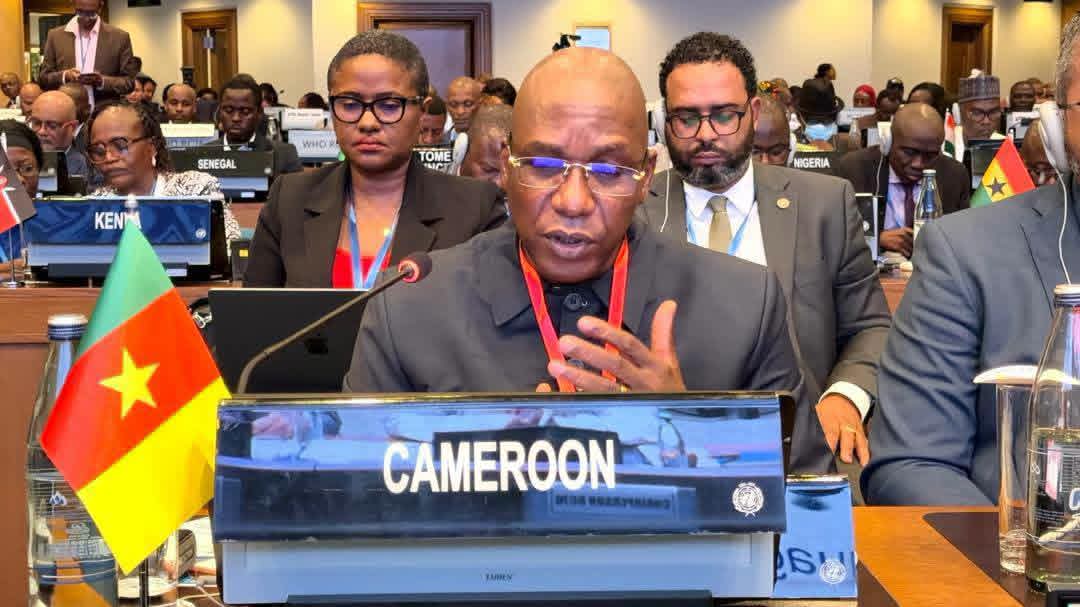
Addis Ababa did not witness the Cameroonian delegation participate as a mere spectator at the 76th session of the WHO Regional Committee for Africa. On August 26, 2026, under the leadership of the Minister of Public Health, Dr. Manaouda Malachie, the delegation delivered consecutive interventions, amplifying Cameroon’s voice across three major public health issues facing the continent.
Speaking on the Regional Health Workforce Management Program 2026–2035 at the United Nations Conference Centre, the head of the Cameroonian delegation highlighted a staggering reality portraying that Africa carries nearly a quarter of the global disease burden yet holds only 3% of the world’s health workforce.
While acknowledging progress, the Minister stressed that current advances still fall short of the regional urgency. He showcased Cameroon’s national multi-year workforce plan, advocated for a more equitable regional strategic framework, and proposed establishing an African observatory to track health personnel dynamics.
In the same venue, Cameroon addressed early childhood development by presenting tangible national achievements, including reducing wasting in children under five to 4.3% and achieving over 90% routine immunization coverage for this age group. However, Dr. Manaouda Malachie candidly noted persistent challenges, such as stunting, suboptimal exclusive breastfeeding rates, and the need to bolster measles vaccination. He requested WHO and partner support to build a National Nutrition policy and a multisectoral strategic plan aligned with global 2030 targets.
The high-tempo day concluded at the Radisson Blu with a ministerial dialogue on expanding access to innovative malaria products. Cameroon actively contributed as a pioneer, having become the first African nation to integrate the malaria vaccine into its routine immunization schedule in January 2024. The delegation reported positive outcomes from this rollout, notably rising coverage rates and declining malaria cases in targeted areas.
The Minister emphasized that this operational success resulted from deliberate strategy rather than chance. He attributed the progress to thorough preparation, seamless integration into existing immunization programs, an upgraded cold chain, well-trained healthcare workers, active community engagement, and real-time data utilization to refine implementation.
Across health workforce development, child health, and malaria eradication, Cameroon engaged on three critical fronts in a single day. This active health diplomacy reflects a straightforward guiding principle: regional commitments made in Addis Ababa are only meaningful if they deliver measurable health outcomes on the ground.