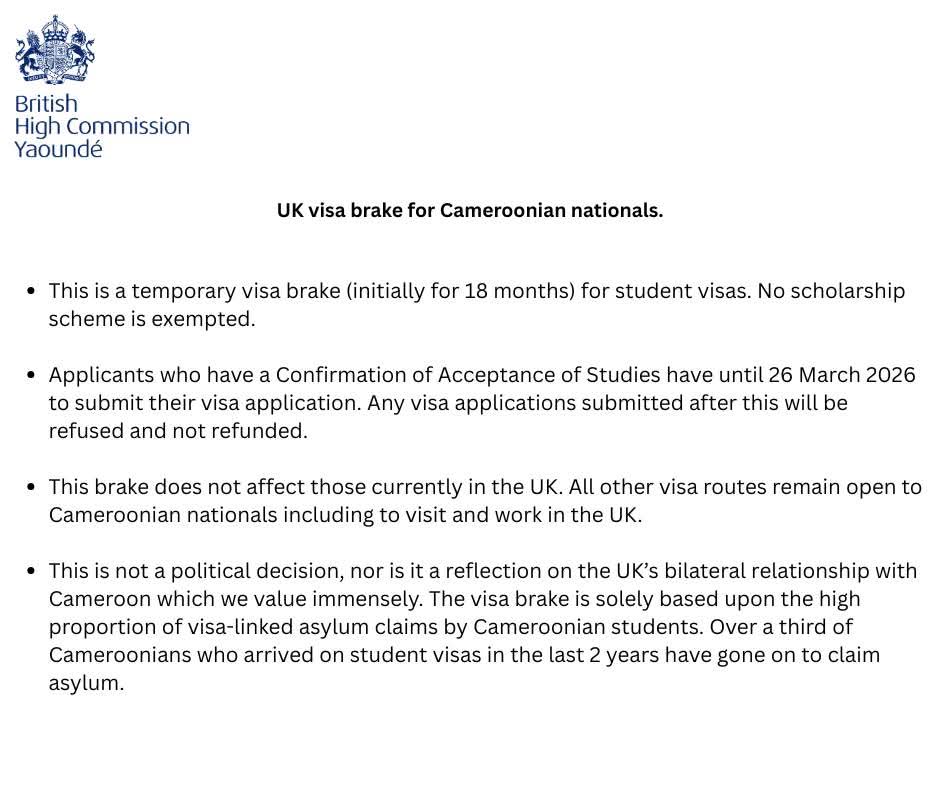
The British High Commission in Yaoundé has officially announced a temporary suspension of student visa issuances for Cameroonian nationals, a measure slated to last for an initial period of 18 months.
In a press release made public by the Embassy, this “visa brake” applies strictly to the student category, meaning that no scholarship programs—regardless of their prestige or funding source—are exempted from this restriction.
However, the diplomatic mission clarified that this policy does not affect Cameroonian students currently residing in the United Kingdom, who may continue their studies without any interruption.
For those currently in the process of applying, a strict deadline has been established: applicants who already possess a Confirmation of Acceptance for Studies (CAS) have until March 26, 2026, to submit their visa applications.
The UK High Commission warned that any student visa applications filed after this cutoff date will be automatically refused, and crucially, no refunds will be issued to the applicants. Prospective students are urged to act immediately if they hold the necessary documentation to avoid financial loss and academic disruption.
British authorities emphasized that this move is not a political statement nor a reflection of the bilateral relationship between the UK and Cameroon, which they continue to value. Instead, the decision is a data-driven response to a significant spike in visa-linked asylum claims.
Statistics reveal that over a third of Cameroonians who arrived in the UK on student visas over the past two years subsequently claimed asylum, prompting the Home Office to implement this cooling-off period to protect the integrity of the immigration system.
Despite the halt on student migration, the High Commission noted that all other visa pathways remain fully operational for Cameroonian citizens. This includes applications for standard visitor visas and various work visa routes, ensuring that professional and personal travel between the two nations can continue.
The 18-month suspension will serve as a monitoring period as both nations navigate the complexities of migration and education exchange during this temporary shift in policy.