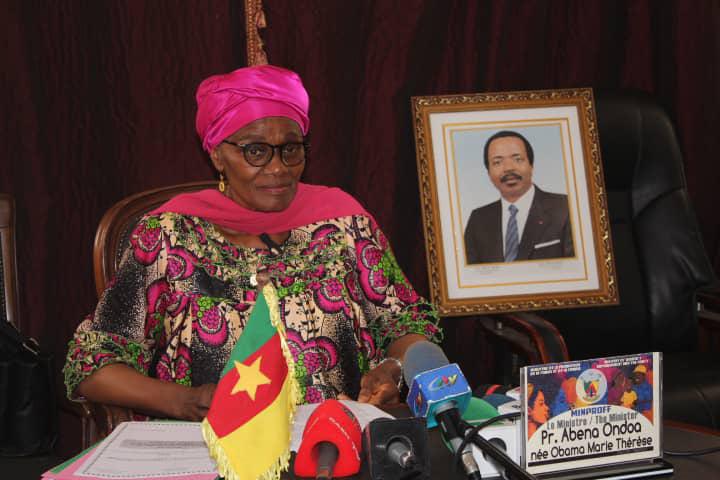
In an exclusive interview, Cameroon’s Minister of Women’s Empowerment and the Family, Prof. Marie-Thérèse Abena Ondoa, addressed the nation’s escalating femicide crisis that had been prominent in the Country.
Following a terrifying wave of deadly domestic abuse, including at least eight reported murders in a single week, the Minister outlines urgent government countermeasures. From a pending parliamentary bill enforcing strict penalties to launching university-backed psychological support networks and economic empowerment schemes, Ondoa highlights the critical priorities to end the violence: breaking societal silence, empowering women, and holding abusers accountable.
Theme: Femicides, leverage points for prevention, government responses, and support challenges.
Q1: Madam Minister, facing the surge in violence and murders targeting women, what concrete measures and actions has the government deployed to eradicate this scourge?
The issue you raise is extremely serious and concerns the entire nation. The Ministry of Women’s Empowerment and the Family, in partnership with other government departments, civil society, and our development partners, has already carried out several interventions to denounce these crimes.
The most recent public statement was a joint press briefing held with the government spokesperson, Minister René Emmanuel Sadi, less than six months ago. Prior to that, female members of the government had also gathered to denounce this very same scourge.
Recently, a series of tragic events occurred in quick succession: the death of young Mathis at Ngoa-Ekelle, the rape of a young girl in the Oza neighborhood a few months ago, and many other tragedies. Well before these events, we had traveled through the sub-divisions of the Mfoundi division at a time when young girls were being murdered on their way to school or their study locations. We went into the field to provide moral support and financial assistance to the families. We even organized an interfaith prayer service at Mimboman-Don Bosco.
These actions demonstrate that the government’s response is not new. However, lately, we are witnessing an alarming normalization of femicides, committed in the most atrocious manners. At present, the situation has reached a critical point: in a single week, at least eight cases were reported to us, not counting those that remain hidden or unmentioned. This points to a deep-seated issue that must be addressed in the most decisive way possible.
On the legislative front, the government has been taking action for several years. The revision of the Penal Code in July 2016 introduced significant amendments to better protect women and children. Furthermore, a specific draft bill dedicated to combating violence against women was initiated. Drafted in consultation with civil society, development partners, and various government departments, this text has been the subject of numerous workshops. It is currently being reviewed at the Prime Minister’s Office, where several meetings are underway to finalize its content. The objective is to secure exemplary penalties for the perpetrators of these crimes.
What makes the situation even more tragic is that these murders are often filmed and shared on social media, exposing young people to this horror. We are witnessing a total loss of respect for human life, particularly the life of a woman. Our wish is for this draft bill to be finalized and submitted to Parliament starting from the November session, so that the law can punish these criminals with the utmost severity.
Q2: As part of the awareness campaigns conducted with your partners, what are the priority leverage points you act upon to prevent these tragedies before they become fatal?
The first essential step is to break the silence. Women tend to endure an enormous amount. In several recent cases, warning signs and repeated violence were present. In one instance, the victim had returned to her parents’ house, but the spouse came to negotiate her return, right before she was tragically found with her throat cut. As soon as violence occurs, it must be reported immediately, and relatives or neighbors must also raise the alarm.
It is important to note that our decentralized reception centers can only shelter victims for a maximum duration of 72 hours. Once calm is restored, they often return to their homes, but the root of the problem lies within the family.
The second major leverage point is the economic empowerment of women. While some victims are targeted regardless of their living standards—like the businesswoman murdered in a hotel in the Fouda neighborhood—many others remain trapped in abusive relationships due to financial dependence. When a woman relies entirely on her partner to meet her needs, she feels diminished and resigns herself to enduring abuse.
This is why economic empowerment is at the heart of our ministry’s priorities, aligned with the directives of the Head of State, who placed this mandate under the banner of supporting women and youth. We are currently working on programs to support vulnerable women and train them in managing income-generating activities, even with modest resources.
Finally, we must restore community solidarity. We must break away from this attitude of indifference where calls for help from a neighbor are ignored. We collaborate closely with law enforcement forces, magistrates, and organizations such as the Association of Cameroonian Women Lawyers (ACAFEJ). But the key element remains psychological support for both the victim and the abuser, because without therapeutic care, the escalation of violence continues. There are even cases where victims who filed complaints withdraw them in court to protect the father of their children.
We must also engage traditional authorities to transform certain customs that guilt-trip women who wish to leave a violent home. Education within families is crucial: a child who sees their father beat their mother will grow up normalizing violence.
Q3: Madam Minister, what fate awaits the abusers and perpetrators of this violence once they are apprehended?
Determining and enforcing penalties falls under the exclusive jurisdiction of the justice system. However, it is essential for the public to be informed of arrests and the legal outcomes of these cases. When criminals are released or escape without proper monitoring, they reoffend.
We must protect victims, but also provide psychological support for abusers to address the root cause of the problem. In this regard, the First Lady strongly committed to fighting this scourge, particularly during the last March 8 celebrations. Under her patronage, a partnership between the Ministry of Higher Education and our ministry initiated a psychological support committee, leveraging 11 state universities to set up counseling units.
To curb this phenomenon, awareness must reach all segments of society. A simple argument can escalate into a fatal blow struck in the heat of anger. If we do not raise awareness about conflict resolution and communication within couples, regret often comes too late—once a human life has already been lost.
Source: Celcom-MINPROFF