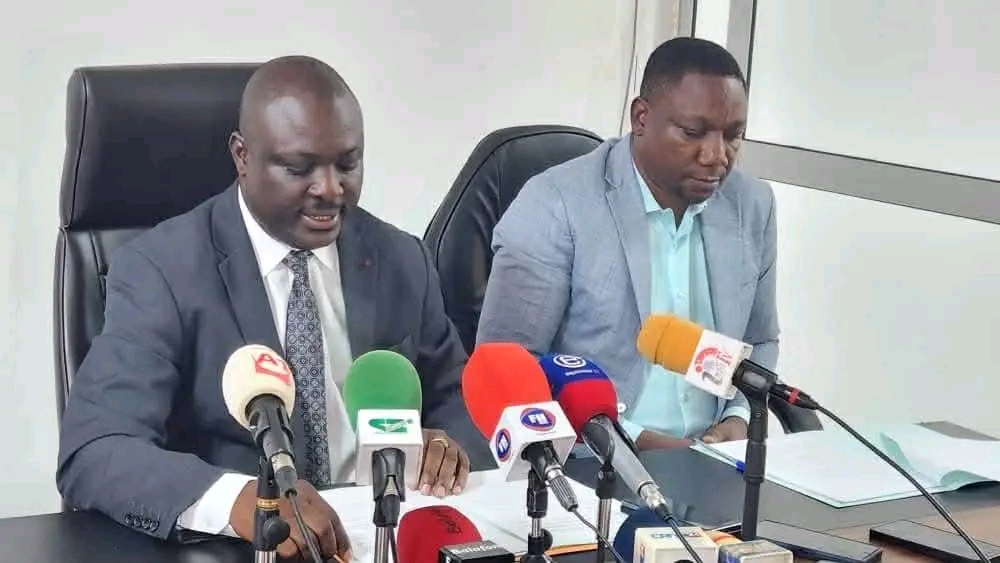
Barely two months to the end of the year marking the festive holiday season, CONGELCAM S.A. broke its usual silence during a press conference on Thursday, October 15, 2026, in Yaounde to issue a stark warning regarding a widespread fish shortage to be witnessed by late November.
Speaking on behalf of the board, Communications Manager Joseph Flavien Kankeu described a grim supply outlook while criticizing a regulatory and tax environment that has become unsustainable.
Founded by Senator Sylvestre Ngouchinghe, the seafood empire, stated that its operations are severely constrained after administrative quotas were halved, urging the government to immediately grant higher import volumes to prevent an impending market crisis.
At the center of this public address is an urgent warning to both public authorities and Cameroonian households: fish could be scarce on dining tables during the holiday festivities.
According to data released by the company, a technical stockout is no longer merely a theoretical risk but an imminent certainty unless swift action is taken. The distributor estimates that local market stalls could be severely depleted by late November 2026, triggering an automatic price surge that may extend through mid-March 2027.
Given that international shipping logistics require an incompressible timeline of one to three months between placing orders and dock delivery in Cameroon, CONGELCAM stressed that every week of administrative delay pushes the market closer to an acute deficit.
To explain this supply strain, the operator points directly to decisions made by the Ministry of Livestock, Fisheries, and Animal Industries – MINEPIA. While CONGELCAM imported 200,000 tonnes of fish in 2025 to meet domestic demand, its initial quota for 2026 was slashed by 50% to 100,000 tonnes, exhausting company reserves in just seven months.
On September 18, 2026, the company formally requested an additional allocation of 100,000 tonnes, but authorities granted only 30,000 tonnes, an amount management calls inadequate, as domestic consumption will absorb it within two months.
The company furthermore questioned the calculation methods used by Société Générale de Surveillance – SGS, accusing the agency of counting expired import declarations to justify restricting authorization volumes.
The company highlighted a sharp contrast between these import limits and its local cold-storage capacity, which includes 104,000 tonnes of installed refrigeration in Douala and an upcoming 10,000-tonne facility at the Port of Kribi. Management dismissed recurring criticisms that CONGELCAM holds a monopoly, noting that MINEPIA has issued technical import notices to roughly 34 authorized operators.
According to the spokesperson, CONGELCAM’s leading market share stems not from special privileges, but from the logistical, financial, and technical constraints of competitors who struggle to supply the market despite holding licenses. The company also reaffirmed the independent journey of its founder, Senator Sylvestre Ngouchinghe, who has built the enterprise through continuous investment and risk-taking since 1982.
In a detailed overview of financial pressures, CONGELCAM outlined ongoing administrative challenges that continue to affect its cash flow. The enterprise remains burdened by a 32 billion FCFA claim stemming from a 2018 CONAC dispute over unpaid 2014 customs duties, an issue still unresolved despite fish imports benefiting from full tax exemptions between 2008 and 2016. Additionally, the company faces growing tax adjustments totaling 11.4 billion FCFA over four years, including 2.2 billion in 2020, 3.2 billion in 2022, and 6 billion in 2024.
The company also cited severe logistical losses, such as the 2023 incident involving 510 refrigerated containers that were unplugged at the Autonomous Port of Douala, causing nearly 13 billion FCFA in direct losses without a final legal resolution. This disruption temporarily affected the firm’s standing with the Central African Banking Commission – COBAC in 2025, freezing major credit facilities until its restoration in 2026.
Furthermore, CONGELCAM alleged unequal customs treatment, stating that while around thirty competitors receive customs discounts ranging between 25% and 30%, CONGELCAM is excluded. The company added that its actual contributions to the Treasury, estimated at 24 billion FCFA in 2025, were understated as 14 billion FCFA in official reports.
In its concluding statement, CONGELCAM reaffirmed its commitment to collaborating with government authorities to maintain national food security, while disclaiming responsibility for potential market disruptions at year-end.
Management emphasized that if Cameroonian households face severe shortages and rising prices, the outcome will result from restrictive administrative policies unsuited to local market demand.
For CONGELCAM, preserving the cold chain and ensuring a stable food supply during the holiday period now depends on prompt ministerial approval to unlock the requested import volumes.