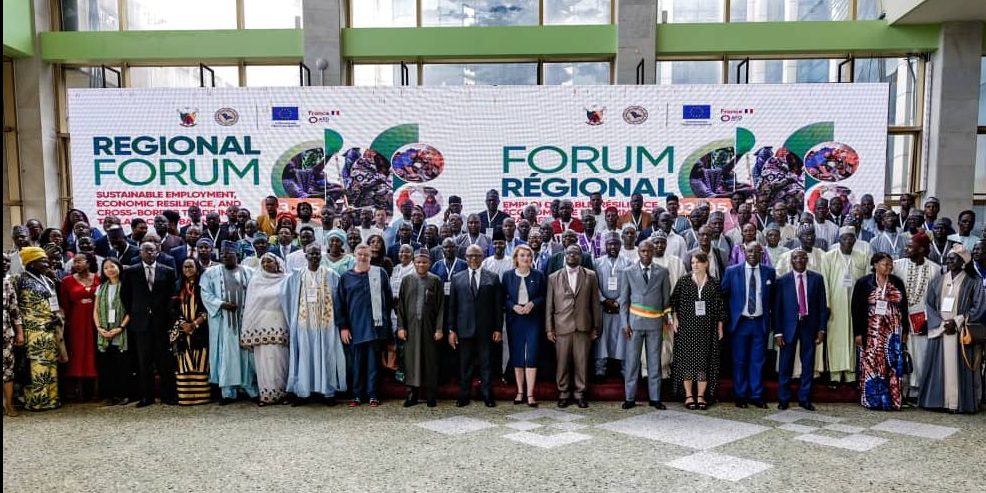
The Yaoundé Conference Centre has become the hub of West and Central African regional cooperation as national and regional institutions, civil society organizations, United Nations agencies such as the IOM, and international financial partners convene for a landmark three-day event. Taking place from November 3 to 5, 2026, the Regional Forum on Sustainable Employment, Economic Resilience, and Cross-Border Trade in the Lake Chad Basin brings together key decision-makers, municipal authorities, and private sector leaders. Organized under the leadership of the Lake Chad Basin Commission (LCBC) and the RESILAC 2 project—co-financed by the European Union and the French Development Agency (AFD)—the assembly addresses the urgent imperative to transform a region long plagued by insecurity and climate vulnerability into an engine of shared economic prosperity.
At the very top of the forum’s priorities is the core mandate to unlock the massive, unfulfilled economic potential of the Lake Chad Basin by shifting the regional narrative from crisis management to sustainable economic opportunities. Delivering the opening address on behalf of Alamine Ousmane Mey (Minister of Economy, Planning, and Regional Development), Cameroon’s Minister Delegate Paul Tasong Njukang stressed that while the basin faces the dual pressures of climate change and security threats, its vast water resources represent an untapped goldmine for agriculture, fisheries, and agropastoral value chains. The primary stake of the gathering is to establish a shared diagnostic and craft an operational regional roadmap that translates these natural assets into viable jobs, positioning local markets to capitalize fully on the African Continental Free Trade Area (AfCFTA).
Second in order of strategic importance is tackling the root drivers of economic instability through fair producer compensation, robust market governance, and the removal of cross-border trade bottlenecks. Cross-border trade is the financial lifeline for millions of households across Cameroon, Chad, Nigeria, and Niger, yet its growth remains severely constrained by non-tariff barriers, fragmented customs services, and inadequate infrastructure. Ambassador Ibrahim Babani, Executive Secretary of the LCBC, emphasized that the Commission’s central responsibility is to harmonize customs regulations, align regional trade policies, and build cross-border communities of practice. Streamlining trade flows and strengthening economic governance are viewed as indispensable steps toward scaling up regional value chains.
A third key priority focuses on creating targeted economic opportunities and social reintegration pathways for vulnerable demographics, particularly youth, women, returnees, and ex-combatants. With widespread unemployment and demographic pressures fueling instability, forum participants highlighted that job creation extends beyond basic economics—it serves as a primary tool for peacebuilding, social cohesion, and crisis prevention. Grounded in the Lake Chad Regional Strategy for Stabilization, Recovery and Resilience (RSS) and recommendations from the February 2026 Abuja workshop on private-sector engagement in DDR (Disarmament, Demobilization, and Reintegration) programs, the forum seeks to equip conflict-affected populations with technical skills, psychosocial support, and entrepreneurship tools.
Underpinning these economic ambitions is the fundamental prerequisite of security, peace, and durable infrastructure, raised as a vital baseline by international development partners. Agnieska Torres de Oliveira, representing the European Union Ambassador, reaffirmed that economic stability cannot exist without security, noting the EU’s continued investments in kinetic support alongside the Multinational Joint Task Force (MNJTF), DDR initiatives, and water management. Echoing this sentiment, Diomande Seve, representative for RESILAC 2 and Action Against Hunger, underscored that while the Lake Chad Basin is a “goldmine of opportunities,” unlocking its full velocity requires urgent, multi-partner investments in trade infrastructure, security guarantees, and expanded access to financing for small businesses and young entrepreneurs.
Fifth in priority is the strategic expansion of Public-Private Partnerships (PPPs) to scale local innovations and bridge financing gaps. Public institutions alone cannot absorb the region’s expanding labor force; hence, connecting institutional policies directly with private capital, financial institutions, and local enterprise is essential. The forum features the Lake Chad Basin Village of Initiatives, an interactive platform showcasing local products, community-led solutions, and agropastoral innovations. By facilitating direct networking among producer organizations, local governments, and private investors, the gathering aims to turn small-scale grassroots successes into scalable, bankable commercial ventures.
The forum also stresses the imperative of institutional inclusion and community-driven decision-making, ensuring that grassroots voices directly shape regional policy formulation. Speakers throughout the opening sessions reiterated that top-down economic models are ineffective unless local communities, civil society organizations, youth leaders, and women’s groups actively participate in defining economic priorities. Incorporating gender perspectives, local knowledge, and mental health and psychosocial support (MHPSS) into employment policies ensures that interventions are tailored to the lived realities of populations residing along border corridors.
Welcoming international delegations to the host city, Simon Mvogo Mboa, First Deputy Mayor of Yaoundé II, captured the spirit of collective responsibility by framing Yaoundé—the “city of seven hills”—as a haven of peace and African unity. As the multi-stakeholder deliberations proceed toward the adoption of a binding regional roadmap, the overarching consensus remains clear: transforming the Lake Chad Basin into a resilient, interconnected trade zone requires translating political commitments into immediate, coordinated action across all four member states.