The Youth Volunteer for Environment association – YVE has made public the launch of a new project dedicated to the Green Climate Fund’s – GCF Independent Redress Mechanism – IRM.
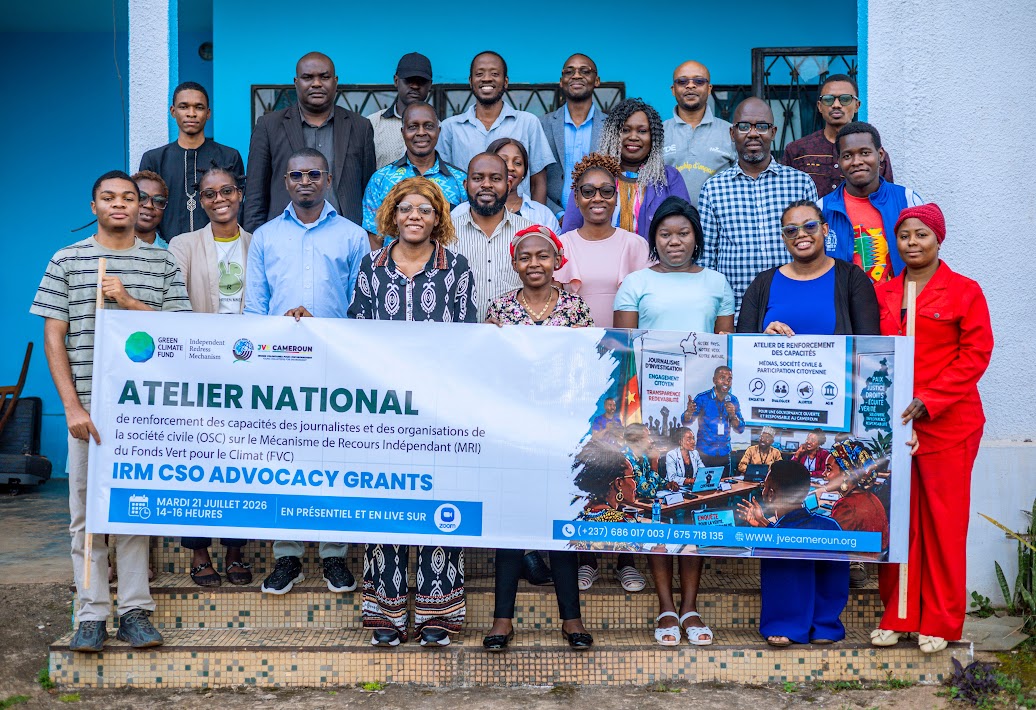
This was during a national capacity-building workshop held in Yaounde on July 21, 2026 that brought together Journalists, Civil Society Organizations, bloggers, and communications professionals. The announcement took place during a hybrid meeting, combining an in-person session with an online broadcast via Zoom.
This mechanism, which remains largely unknown to the general public, allows communities affected by climate-funded projects to voice their grievances to the relevant institutions. Through this new project, YVE Cameroon aims to address the information gap by training opinion leaders capable of popularizing the tool among local populations and engaging public decision-makers.
Thirty participants, including 13 women and 17 men—fifteen of whom were journalists, bloggers, and communicators—took part in the workshop through both interactive and educational activities on the IRM.
It is worth noting that it is the third time the association has been selected to lead this awareness campaign, confirming the organization’s role as a key partner on climate accountability issues in Cameroon.
The project also includes field activities, particularly in Ngong, in the North Region, where communities living near climate projects will be directly equipped with knowledge about their rights and available avenues for recourse.
For Blondel Silenou, who leads this initiative, the stakes go beyond mere information: “Above all, this project is a matter of climate justice. Many communities suffer the impacts of projects funded in the name of climate without knowing that a mechanism exists to make their voices heard. Being chosen for the third time to lead this campaign is a sign of trust, but above all, it is a responsibility: that of bringing this information down to the very last village, in Ngong and beyond.”
With this new project, JVE Cameroon aims to consolidate its role as a bridge between international climate institutions and local populations, who are often the first to be affected, but the last to be informed.