Child labour is a alarming situation in Cameroon especially as it hinders Children from the right to education and a home.
A young boy, barely nine years old, is the bread winner of an entire family. He provides for his parents and siblings, taking care of their basic needs. The most baffling thing is the fact that his Father and mother who live in Manjo receive monthly allowances of FCFA 100,000 each from the young boy, same as his siblings – 2 elder sisters and 2 junior ones who are just 2 years old – who are entitled to the sum of FCFA 50,000 each. These children, who under normal circumstances have to benefit from parental control, the comfort of a home, are already “matured enough” to take care of themselves and their family. The take care of responsibilities which are those of matured persons.
The fact that they are very versed with manipulation of huge sums of money at a very tender age make them think of nothing else asides making more gains. Taking care of their family members, providing for the family and being ‘independent’ at a very tender age makes it difficult, if not impossible, for these children, who barely know the importance of education to nurture the idea of going to school to acquire some knowledge and develop skills.
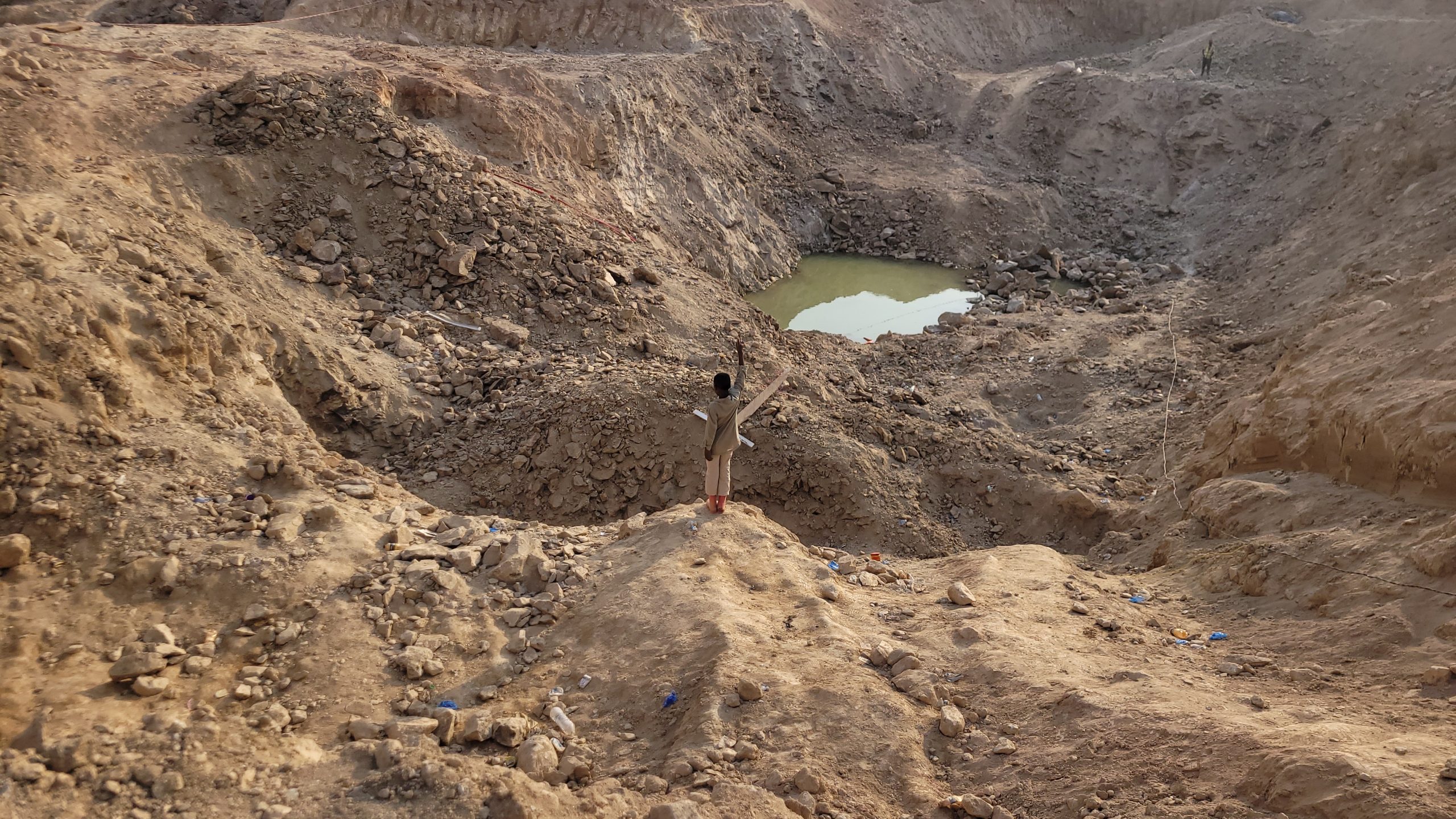
This is the reality of Oumarou Bouba, a Central African refugee living in Batouri and working at the Kambele mining site. He is one of the many children that work in the Kambele mining sector.
While children of his age are in class rooms with uniforms, pens, books and other school equipment with the goal of gaining knowledge, Oumarou is on the Kampele mining site, dressed in casual wear, boots, with a stick in hand aiming only for one thing; acquiring more gold. This exposes him to the havoc of the profession.
Growing up, Oumarou wish is to construct hospitals and orphanages where orphans, children who face the same situation like him as well as the elderly will be entitled to free meals once every week. A thought which is generally harbored by adults of a certain age. For survival in Cameroon, the 9-year-old is entitled to the refugee grant of FCFA 5,000 daily which he manages like a ‘Professional’.
Mining in this part of the Country is centered on artisanal gold mining, which serves as a major economic activity for the local population, with roughly 66% of residents relying on it for their livelihood. The sector has been characterized by significant controversy, including environmental destruction, the use of child labor, fatal accidents in abandoned pits, and conflicts between local miners and industrial/semi-mechanized companies.
Workers in this area are exposed to land slides and serious health issues which emanates from their daily contact with toxic chemicals like mercury. Oumarou is not exempted from this havoc as he suffers from inability of blood clotting, or coagulopathy, which occurs when blood cannot clot properly due to insufficient platelets or proteins called clotting factors, causing prolonged bleeding.
Since 2019, there has been a development in the Kambele mining sector. As of date, the number of mining sites has increased to 200. The sale of gold is well coordinated such that only renowned and affiliated organizations and enterprises are able to make purchase. Wealthy Muslims can also buy but in limited quantity.
Workers on the site are mostly refugees from neighboring countries like Central African Republic, Chad, and other African countries like Senegal as well as Internally displaced persons who flee from unrest in conflict regions of Cameroon like the Far North, North and Adamawa.
The mining sites in Kambele has been identified as having serious issues with child labour, which has been highlighted by Non-Governmental Organizations like Plan Cameroon and local observers as a consequence of poverty and a lack of educational opportunities.
Most of the girl children living in the locality go to school and only go into marriage at a matured aged. The few that get into early marriages are most often Muslims who try to follow the tradition. The male children on prefer mining. This situation has prompted the local authorities in collaboration with the government through the forces of Law and order to fight against this lapse.
According to His Majesty Baba Bel, 3rd Degree chief of Kampele 3, they have devised several strategies and methods geared towards sensitization of the population on the importance of education. Workshops are being organized during holiday periods where parents are being sensitized and any child of school going age caught in the mining site during school period is immediately taken to the police station and the parent called to order.
About children
Children have a unique and privileged place in the society since they fall under the category of vulnerable group of human beings just like women. But often, their due rights are trampled upon either consciously or unconsciously. They are subjected to various forms of child labor. They are found hawking in streets, markets and public spots, carrying loads of items varying from dresses, fruits, electronics, fast foods to other merchandise.
In order to find potential buyers, they are obliged to crisscross roads as well as gallivant the nooks and crannies of towns and cities, and are exposed to accidents, kidnappings and theft.
Internationally and national, two dates are consecrated to the celebration and commemoration of children and their rights. There is the International Day of the African Child, also known as the Day of the African Child, celebrated every June 16 since 1991. The second one is the World Children’s Day which is UNICEF’s global day of action for children, by children, marking the adoption of the Convention on the Rights of the Child on November 20. Around the world, children are standing up and talking about their lives, their hopes, and their rights.
Laws and conventions protecting children
Convention on the Rights of the Child (UNCRC) is the primary international treaty, adopted in 1989, protecting children under 18 through 54 articles covering civil, political, economic, social, and health rights. Key principles include non-discrimination, the best interests of the child, survival/development, and participation.
Cameroon has ratified a series of laws and conventions for the protection of children’s rights. There is the UN Convention on the Rights of the Child (1990/1993) and the African Charter on the Rights and Welfare of the Child (1997). Key national laws include the Penal Code (Sections 80-86), Labour Code, and Law No. 2023/009 of 25 July 2023 on child online protection. NGO’s like Plan International Cameroon as well as civil society organizations are on the move relenting no effort to see to it that the objectives of these conventions are attained.
Key International Laws and Conventions
UN Convention on the Rights of the Child (UNCRC): The most widely ratified treaty, covering rights to education, health, protection from violence, and family life.
Optional Protocols to the UNCRC: Specifically address child involvement in armed conflict, sale of children, child prostitution, and child pornography.
The Hague Convention on Adoption: Protects children and families against illegal or illicit adoptions.
ILO Convention No. 182: Prohibits the worst forms of child labor.
Geneva Conventions (and Protocols): Protect children in armed conflicts and situations of war.
African Charter on the Rights and Welfare of the Child: Tailors rights to the African context, emphasizing family and culture