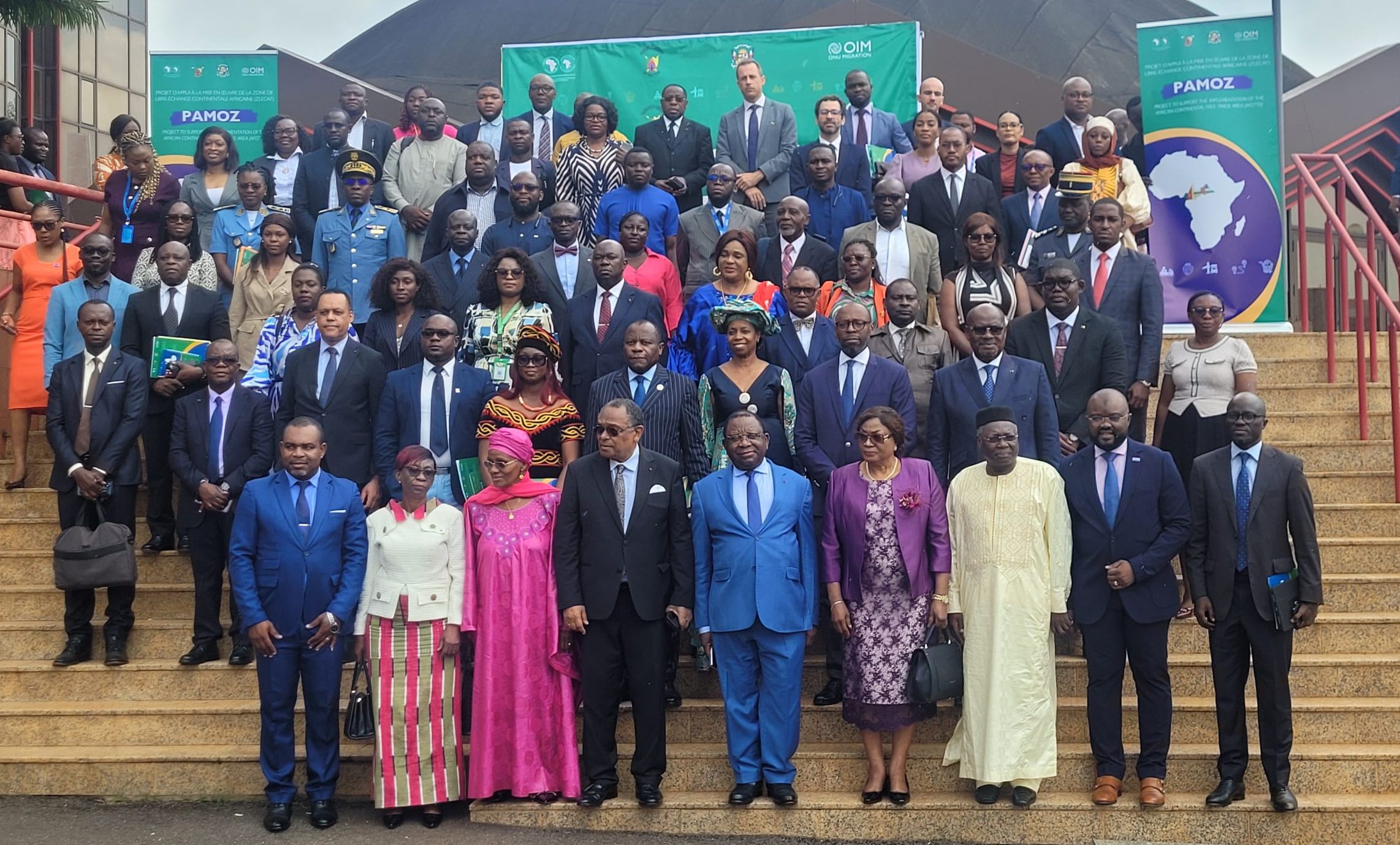
The official launch of the Project to Support the Implementation of the African Continental Free Trade Area – AfCFTA to promote cross-border trade took place on October 6, 2026, at the Economic and Social Council Headquarters in Yaoundé. Presided over by Cameroon’s Minister of Trade, Luc Magloire Mbarga Atangana, the ceremony brought together key government officials, including ministers from Social Affairs, Public Works, Small and Medium-Sized Enterprises, and the Promotion of Women and the Family. Co-developed by the International Organization for Migration – IOM and the African Development Bank – AfDB, the initiative is designed to turn critical Central African transport corridors into hubs of economic growth, inclusion, and resilience.
The project targets two vital transport axes in Central Africa: the Douala-Bangui corridor connecting Cameroon to the Central African Republic – CAR and the Douala-Kousséri corridor connecting Cameroon to Chad. While these transit routes serve as primary lifelines for regional trade and human mobility, they face complex systemic challenges, including institutional fragility, persistent security risks, limited access to formal finance, and heavy border administration delays. By addressing these obstacles, the project seeks to strengthen regional integration while enhancing the socio-economic resilience of vulnerable border communities, small-scale traders, women, youth, and displaced persons.
Totaling approximately €2.76 million ($2.9 million), the 24-month project is primarily funded through Pillar 3 of the AfDB’s Transition Support Facility with €2.4 million, alongside a contribution of roughly €360,000 from the IOM under a tripartite agreement signed in April 2026. The intervention directly targets 500 small-scale cross-border traders focusing heavily on women and youth entrepreneurs and is estimated to indirectly benefit more than 10,000 households.
Key pillars of action include strengthening data collection on human mobility, facilitating business formalization and financial inclusion, and promoting Integrated Border Governance – IBM across shared borders.
Speaking at the event, Minister of Trade Luc Magloire Mbarga Atangana underscored the strategic imperative of the AfCFTA, highlighting that a unified market of 1.3 billion consumers offers unprecedented opportunities for African economies. Minister Mbarga Atangana emphasized that facilitating cross-border trade and managing population mobility are integral to Cameroon’s National Development Strategy – SND30, which prioritizes local processing and value creation. He commended the AfDB and IOM for funding a concrete mechanism that directly addresses non-tariff barriers and empowers small-scale traders who form the backbone of sub-regional commerce.
Representing the African Development Bank, Pierre Ollame Bekale, Principal Country Program Officer, highlighted that the project aims to turn trade into a powerful tool for resilience in fragile zones. He noted that the AfDB’s commitment focuses on tackling root causes of fragility by equipping national AfCFTA committees, closing data gaps on cross-border mobility flows, expanding financial inclusion for small and medium-sized enterprises, and actively mobilizing the African diaspora to contribute investment and technical skills.
Echoing these priorities, H.E. Jeannette Marcelle Gotchanga née Betizamo, Ambassador-Designate of the Central African Republic to Cameroon, emphasized the strategic importance of the corridors for landlocked nations. She described the Douala-Bangui corridor as a vital economic “umbilical cord” for the Central African Republic, noting that any delay along the route directly impacts market prices and household living conditions in Bangui.
Expressing CAR’s full commitment to the initiative, she called for simplified border procedures, upgraded civil status systems, and enhanced bilateral cooperation to turn shared borders into zones of stability and economic opportunity.
Delivering the inaugural presentation, IOM Chief of Mission Abdel Rahmane Diop outlined the operational tools driving the project, including the Migration Information and Data Analysis System – MIDAS and the Displacement Tracking Matrix – DTM.
Diop highlighted IOM survey findings revealing that cross-border traders account for over 30 percent of border crossings far exceeding general travelers, humanitarian workers, and local residents. He urged a transition from traditional border controls to Integrated Border Management – IBM and One-Stop Border Posts, emphasizing that smooth, coordinated border checks protect human dignity while driving commercial competitiveness.
The initiative also aligns directly with Cameroon’s ongoing formulation of its future National Migration Policy, led by the Ministry of External Relations under presidential directive. The upcoming policy framework views migration through a strategic development lens framing Cameroon simultaneously as a country of origin, transit, destination, and return.
By integrating trade and human mobility into national planning, the government aims to ensure safe, orderly migration that generates employment, attracts diaspora investments, and elevates sub-regional value chains.
Implementation will be overseen by a dedicated Project Management Unit managed jointly by IOM offices in Cameroon and the Central African Republic, working in close coordination with the respective ministries of trade, border authorities, and local government bodies.
The execution team will prioritize capacity building, structured dialogue with traders’ associations, and direct support to local cooperatives, ensuring that interventions directly respond to the daily operational realities of cross-border operators.
With formal operations underway following the launch ceremony, stakeholders from both nations emphasized moving rapidly from strategic vision to on-the-ground execution.
By streamlining border management, empowering female and youth traders, and deepening institutional collaboration between Cameroon, CAR, and Chad, the AfDB-IOM project aims to establish a benchmark for converting trade corridors into durable pathways for sustainable development and regional stability.