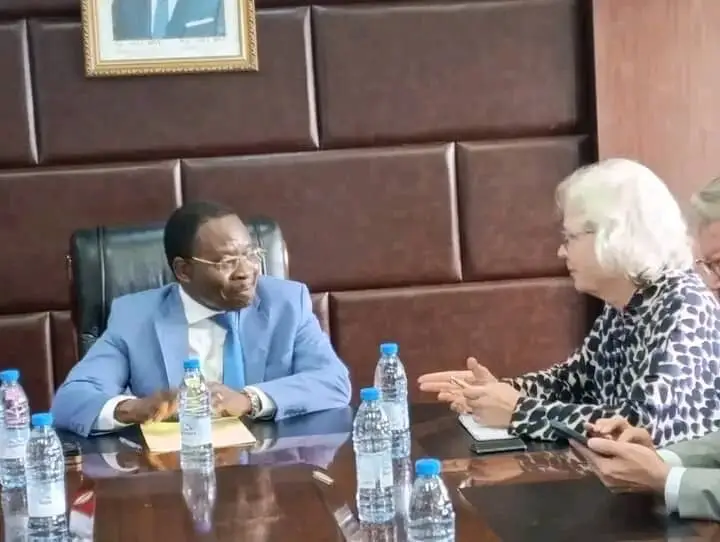
Cameroon’s Minister of Water and Energy, Gaston Eloundou Essomba, alongside senior ministry officials, hosted an International Monetary Fund – IMF delegation led by Mission Chief Christine Dieterich on Monday, September 21, 2026.
The bilateral discussions focused comprehensively on the operational and financial health of the national power sector. Addressing issues spanning power generation, transmission infrastructure, loss reduction, and growing consumer demand, Cameroonian authorities provided a transparent overview of current structural bottlenecks while presenting strategic roadmaps designed to stabilize the power grid.
While acknowledging ongoing supply disruptions, the Ministry outlined key initiatives underway to enhance service quality through targeted infrastructure rehabilitation. A primary focus involves upgrading high-voltage transmission networks, increasing transformer substation capacities, and fortifying distribution corridors.
Notably, to address power drops caused by decaying wooden infrastructure, the government has launched a World Bank-supported project to substitute 50,000 of the nation’s 1.5 million wooden poles with concrete alternatives across all ten regions, prioritizing critical supply lines.
The operational status of the Nachtigal Hydroelectric Power Plant formed a central pillar of the consultation. Although the facility’s production infrastructure is fully operational, Minister Eloundou Essomba detailed how fluctuating hydrological conditions and seasonal water shortages currently prevent the plant from consistently generating at its maximum installed capacity. This reality underscores the vulnerability of the national grid to hydrological risks and highlights the urgent necessity to diversify energy sources to meet expanding consumer requirements.
To maximize the impact of available power, accelerating energy transport infrastructure remains a top priority. While Nachtigal’s output successfully reaches Yaounde, active construction is focused on completing the high-voltage transmission corridor to Douala, the country’s primary industrial center.
Contractors working on the remaining segments have been directed to expedite construction, with official targets aiming to render the entire Yaoundé–Douala evacuation corridor operational before the end of 2026.
In tandem with grid expansion, authorities emphasized the imperative to curb significant technical and commercial losses that undermine the sector’s financial sustainability. Resolving these leaks requires a combination of network modernization, rigorous preventative maintenance, and heightened measures against electricity fraud. Confronting a continuous rise in domestic and industrial demand, the government outlined emergency supply initiatives, including a planned 200 MW rapid-deploy solar program and capacity restoration at existing facilities.
Looking toward medium-term stability, discussions highlighted expansion plans for the gas-fired power plant in Kribi to generate immediate base-load capacity ahead of larger infrastructure rollouts. Ministry officials reiterated that securing a reliable, high-volume energy supply extends beyond basic utility provision; it is an essential prerequisite for sustaining industrialization and broader economic growth.
The high-level exchange paved the way for Cameroon to align its sector reform commitments with IMF monitoring, reinforcing a shared emphasis on sustainable energy governance.