Cameroon has officially embarked on a major new phase in the modernization of its agro-industrial sector with the launch of the Agri-Connect Pact.
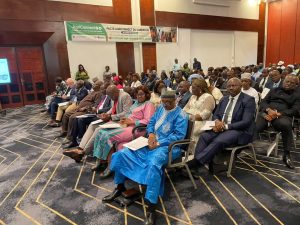
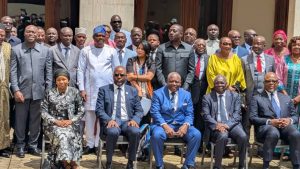
Co-chaired by the Minister of Livestock, Fisheries and Animal Industries Dr TAIGA, that of Agriculture and Rural Development Gabriel Mbairobe and Paul Tasong, Minister Delegate to the Minister of Economy, Planning and Regional Development, the ceremony brought together key technical and financial international partners, including the World Bank and the International Fund for Agricultural Development – IFAD, alongside private sector leaders from the Cameroon Business Executive Group – GECAM.
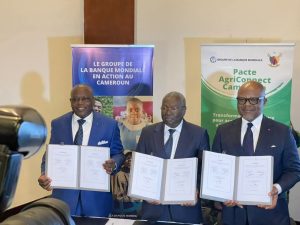
Spearheaded with support from the World Bank Group, this initiative is designed to empower smallholder farmers, catalyze public and private investments, and guarantee long-term national food security.
Spanning the period from 2026 to 2030, the Agri-Connect Pact targets focused interventions across eight strategic value chains: cocoa, rice, cassava, palm oil, soybeans, milk, aquaculture, and fisheries.
To drive these critical sectors forward, the overall financing requirements are estimated at 1,119.9 billion FCFA (approximately $1.8 billion USD). By mobilizing these funds, the initiative aims to expand domestic production, boost local processing capacities, and significantly reduce the nation’s heavy reliance on costly food imports.
Additionally, it seeks to generate sustainable employment, raise incomes for local producers, and foster a competitive ecosystem of national agribusinesses.
The strategic selection of these eight value chains reflects their central role in meeting domestic demand and their high growth potential. In crop agriculture, the pact emphasizes local processing and value creation for cocoa, boosting production to satisfy internal demand for rice and maize, and expanding cassava processing for product diversification.
Similarly, scaling up palm oil and soybean production aims to streamline supply chains and bridge domestic shortages. In the animal and fisheries sectors, interventions in dairy production, aquaculture, and capture fisheries are designed to increase the availability of animal proteins through improved farming systems, access to quality inputs, and upgraded cold storage infrastructure.
To achieve its ambitious goals, the Agri-Connect Pact operates across three primary pillars: upgrading agropastoral infrastructure and technical capabilities, implementing institutional and regulatory reforms to enhance business competitiveness, and strengthening the financial ecosystem by mobilizing public and private investments, engaging commercial banks, and building strategic partnerships.
By addressing the entire agro-industrial chain, from farm-level production and storage to processing, transport, and commercialization, the pact aims to elevate Cameroonian products in both local and international markets.
Fully aligned with the goals of Cameroon’s National Development Strategy 2020–2030 – SND30 and its national import-substitution policy, the Agri-Connect Pact serves as a cornerstone for agricultural modernization.
Looking ahead to 2030, the ultimate test will lie in converting these ambitious financial targets into tangible field outcomes through effective capital mobilization and tight coordination among government bodies, international development partners, local producers, and private investors.