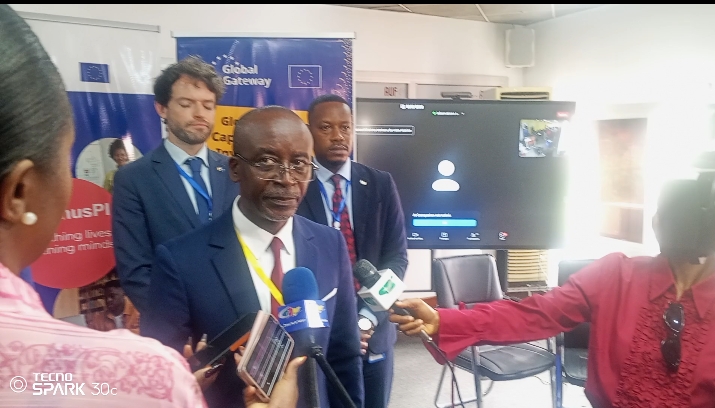
The Delegation of the European Union to Cameroon organized an Erasmus+ information session as part of Erasmus+ Week 2026, held on October 15, 2026, at the Agence Universitaire de la Francophonie – AUF located at the University of Younde 1.
The event brought together key stakeholders in a hybrid format, combining in-person participation in Yaoundé with online broadcasting for other regions.
The Erasmus+ program aims to support the educational, professional, and personal development of individuals at all stages of life, ranging from school to professional life. Special attention during the promotion day was directed toward capacity-building actions in higher education – CBHE, vocational education and training – CBVET, and youth – CBY.
During the opening remarks, Mr. Kabirou Mohamadou, the AUF Country Representative for Cameroon, welcomed participants and highlighted that Erasmus is a strategic program for transforming higher education. He noted that its momentum aligns completely with AUF priorities like training quality, pedagogical innovation, digital transformation, research, youth employability, and university cooperation.
Julien Abratis, Deputy Head of Partnerships at the Delegation of the European Union, explained that Erasmus provides funding opportunities to support education and young people, focusing on higher education, vocational training, and youth organizations. He emphasized that the initiative aims to transfer skills to address challenges, aligning with the EU’s Global Gateway strategy by building the workforce required for infrastructure, energy, transport, and digitalization.
Reflecting on past successes, Julien Abratis pointed out that over the previous year, three projects involving seven different Cameroonian institutions successfully secured funding, facilitating exchanges between Europe and Cameroon. The objective is now to increase this number and expand into vital fields such as agriculture.
Jean Luc KONAN further reinforced that these information sessions ensure available funds from the European Union to support sub-Saharan countries are effectively shared. By passing information through higher education institutions, more students and organizations gain the capacity to participate in future developmental projects.