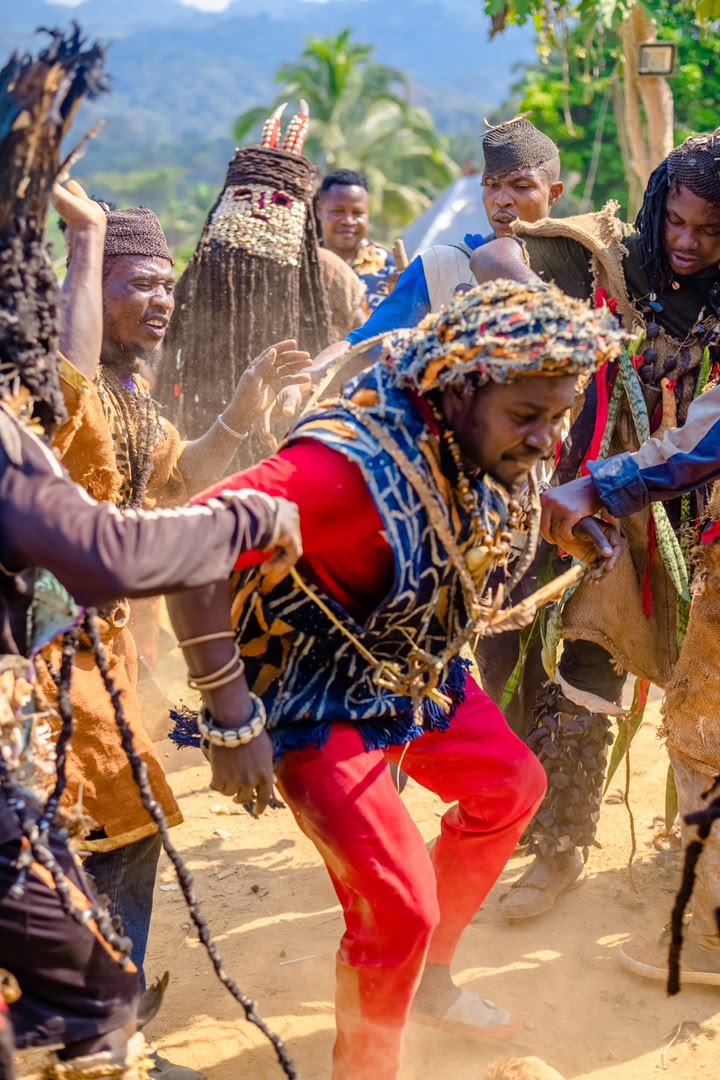
A historic chieftaincy has awakened in Cameroon’s western Haut-Nkam region after more than two centuries of silence.
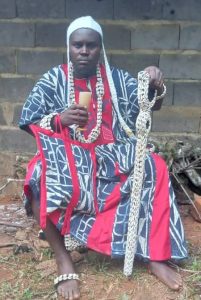
Enthroned in 2021 following an extensive initiatory journey, Fo’o Tchamaleu Luminaire Ndia Shugaïnto II, legally known as Tchamaleu Gabriel Bruno, stands as the living continuation of a royal lineage long thought dormant.
Rising through the region’s most influential traditional brotherhoods, his ascension restores the sacred heritage of Banwa Nation Ndoh-Sissog, reconnecting a community to its ancestral roots.
The origins of this chieftaincy trace back to the 18th century under the reign of Fo’o Kouati Ndia Shugaïnto, a powerful warrior king and early figure of resistance against colonial encroachment. Between 1700 and 1800, his authority spanned key territories across modern-day Haut-Nkam, including Banwa, Moumé, and Kekem.
He deliberately established his seat of power at Ndoh-Sissog, a name meaning “above the sissongho,” the tallest grass in the forest to symbolize his unmatched dominance over the land and all rivals.
Following the warrior king’s death, however, the throne fell silent for 250 years. A fierce succession crisis fractured the royal household, claiming the lives of several heirs while colonial pressures drove others into exile from their ancestral lands. Despite the turmoil, the bloodline endured through one of the late sovereign’s direct sons, Djongoué, who passed the royal legacy down to his only son, Namenou David.
Residing in Banwa-Makongo, Namenou David dedicated his life as a high-ranking initiate and custodian of oral history to reviving his family’s birthright. He meticulously traced his genealogy, recovered lost traditional insignia, and reclaimed ancestral territories. Crucially, he spearheaded the reconstruction of the sacred traditional space at Ndoh-Sissog, naming it “Nation” to signify a foundational place of origin and spiritual connection for the dispersed lineage.
When Namenou David passed away on May 19, 1999, the mantle of leadership fell to his youngest son, Tchamaleu Gabriel Bruno, whose destiny as heir had been foretold by signs and omens at his birth.
By ascending the throne as Fo’o Tchamaleu Luminaire Ndia Shugaïnto II in 2021, he fulfilled decades of ancestral groundwork, bridging centuries of interrupted history and ushering in a new era for Banwa Nation Ndoh-Sissog.