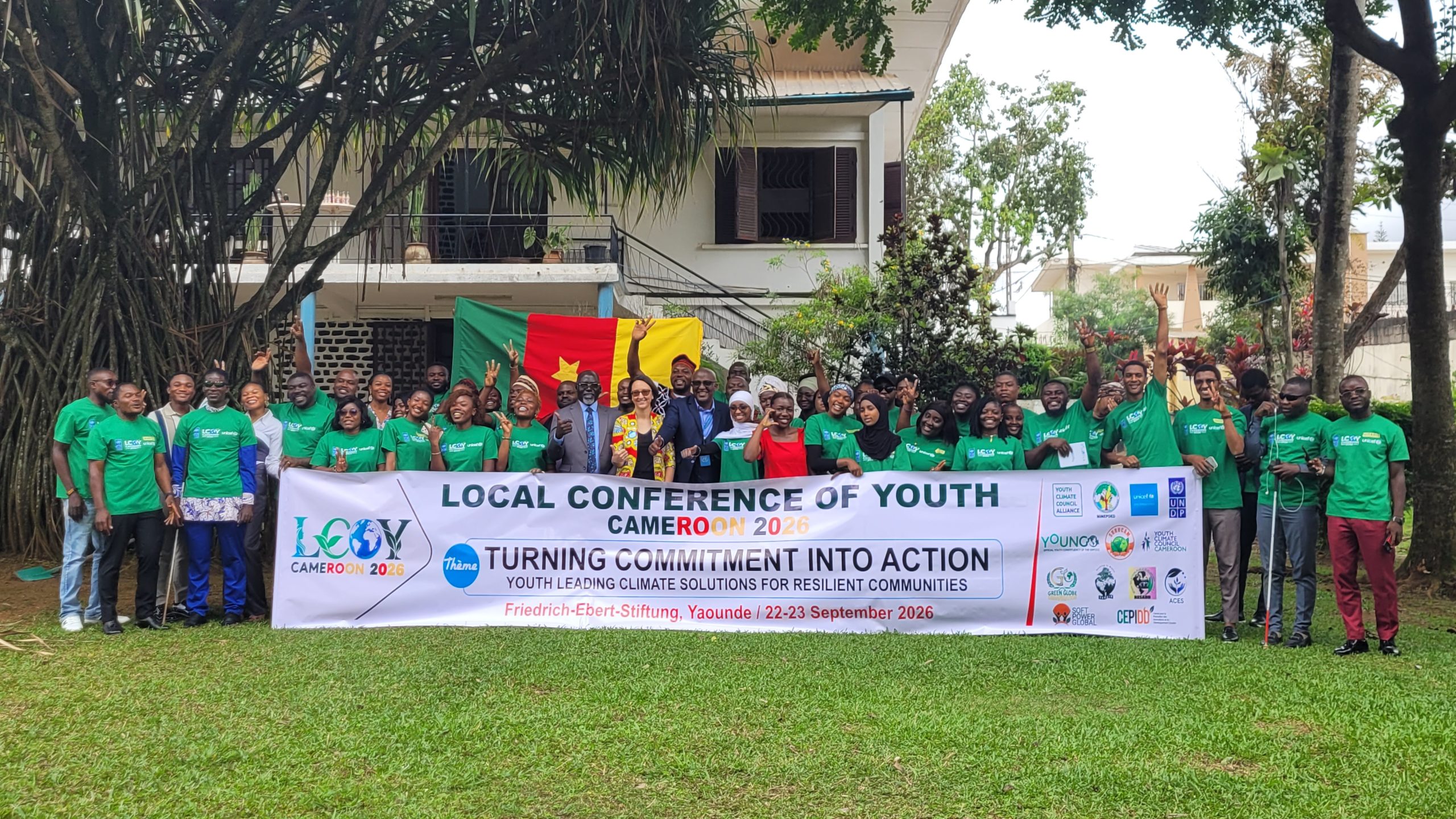
Fifty dynamic youth representatives from across all ten regions of Cameroon gathered in Yaounde at the Friedrich Ebert Stiftung office for the Local Conference of Youth – LCOY 2026.
Organised by Support Humanity Cameroon – SUHUCAM alongside a coalition of seven partner youth-led non-governmental organizations, the two-day conference brings together young climate advocates, youths from indigenous communities, and policy stakeholders. Under the theme “Turning commitment into action: Youth leading climate solutions for resilient communities,” the gathering served as a vital forum for capacity building, peer learning, and collaborative strategy formulation to elevate youth perspectives in national and global climate governance.
The event benefited from significant technical and financial support provided by the United Nations Development Programme – UNDP Cameroon, UNICEF Cameroon, and the Ministry of Environment, Protection of Nature and Sustainable Development – MINEPDED. During the opening ceremony, institutional leaders highlighted that meaningful youth inclusion is essential for sustainable climate mitigation and adaptation. Timothee Kagonbe, MINEPDED’s UNFCCC Focal Point for Cameroon, stressed that because young people will bear the long-term impacts of climate change in the coming decades, they must be actively equipped with technical policy knowledge, accredited, and integrated into official government delegations to global climate summits.
Highlighting the distinct vulnerabilities across Cameroon’s diverse geographic zones, Mrs. Juliette Haeni, Deputy Representative at UNICEF Cameroon, emphasized that local youth are uniquely positioned to spearhead community-level resilience.
From tree planting initiative to emergency responses like deploying sandbags during severe flooding in the Far North to ensure school access, youth initiatives such as the U-Reporters demonstrate practical leadership. Haeni urged participants to articulate the distinct regional realities of “Cameroon in miniature” while developing scalable, locally driven solutions that can be championed on the international stage.
Inclusivity and targeted vulnerability assessments formed a core pillar of the summit’s deliberations. Disability advocate and conference participant Nguini Simone called attention to the disproportionate dangers extreme weather events present to persons living with disabilities, particularly regarding inaccessible infrastructure during sudden floods in major hubs like Yaoundé and Douala. Simone emphasized that organizations representing persons with disabilities must be formally consulted during disaster risk reduction planning to ensure inclusive emergency response strategies that protect the most vulnerable populations.
Local community adaptation strategies were vividly illustrated by Sufyaan Ibrahim, a climate advocate from the Mbororo pastoralist community. Ibrahim shared how shifting weather patterns and traditional land disputes sparked by eucalyptus planting severely threatened livestock productivity and traditional livelihoods.
To address these challenges without resorting to long-distance transhumance, his community revolutionized grazing by cultivating drought-resistant Brachiaria grass across multiple hectares, significantly reducing cattle travel distances and mitigating farmer-grazier tensions a concrete example of indigenous-led climate adaptation shared during the conference.
Despite the impact of these grassroot initiatives, youth advocates face persistent structural barriers, particularly around funding mobilization and institutional trust. Queeniver Ngwangung, Youth and Advocacy Lead at SUHUCAM and Land Youth Negotiator, noted that resource constraints often hinder youth-led climate organizations because external partners prioritize legacy experience over active competence. However, by pooling resources within an eight-organization coalition, LCOY 2026 successfully demonstrated the collective strength and organizational capacity of youth-led networks to secure funding and drive impactful policy dialogues.
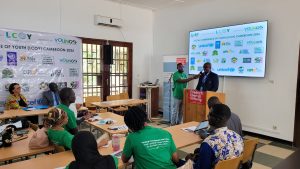
Aime Kamga representing UNDP shared the various opportunities that exist for young people with the institution while acknowledging that youth action serves as a vital platform to empower young people, who represent about 65% of the population, to lead the fight against climate change through innovation, entrepreneurship, and active governance. Furthermore, he presented the commitment of the 2027–2031 program geared towards investing in green jobs, education, and climate resilience, recognizing that sustainable solutions stem from local communities and young visionaries. Kamga concluded by reaffirming government stand of empowering youth to be solution providers.
Looking forward, LCOY Cameroon 2026 serves as the focal point of an expanded national consultation process encompassing regional discussions, thematic workshops, and capacity-building tracks. According to Tuombouh Sandra, LCOY 2026 Cameroon Focal Point, the primary deliverable of the conference is the drafting of the National Youth Statement.
This policy document will consolidate the priorities of Cameroonian youth, feed into the global Conference of Youth – COY in Turkey, and be submitted to YOUNGO, the official youth constituency of the UNFCCC and MINEPDED negotiators to directly shape government positions ahead of COP31.