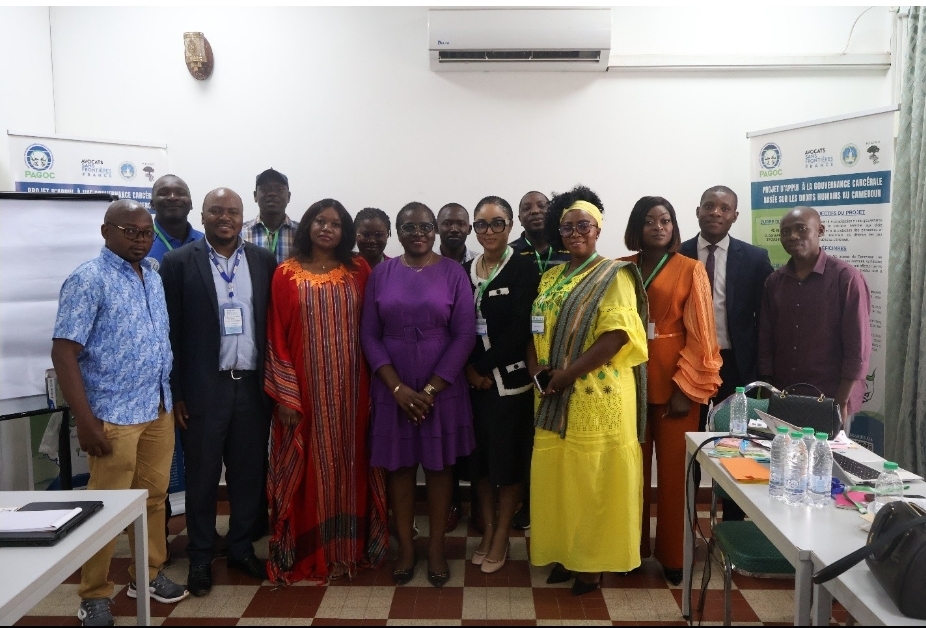
The Cameroon chapter of Avocats Sans Frontières – ASF France hosted a capacity-building workshop on September 9 at its Yaounde office to equip local journalists with the skills needed for ethical and legally accurate reporting.
Organised under the Support Project for Human Rights-Based Prison Governance in Cameroon – PAGOC, the event brought together reporters, editors, and presenters ahead of a national colloquium on alternative penalties scheduled for September 23.
Participants were trained on utilizing precise judicial terminology, verifying information, and respecting the privacy and human dignity of detainees to avoid exposing vulnerable sources to potential reprisals.
Highlighting the vital role of the press in judicial reform, ASF France Country Representative, Barrister Dr. Dacga Djatche Sandrine Bergeline, emphasized that media professionals are central to improving prison governance. She noted that while Cameroon’s revised Penal Code introduced community service and reparation penalties in 2016 under Sections 18 and 26, their practical application remains stalled due to the absence of a specific legal instrument guiding magistrates. Barrister Dacga urged journalists to help demystify these legal options, explaining that alternative sentences offer a constructive way to rehabilitate minor offenders without alienating them from their families and professions.
The push for alternative sentencing comes amid severe structural challenges, particularly severe overcrowding and high rates of pre-trial detention across Cameroonian prisons. According to Barrister Dacga, many individuals wait in custody for minor offenses longer than the actual length of the sentences they would face if convicted. She specified that alternative penalties are designed for offenses carrying maximum prison terms of under two years, explicitly excluding severe crimes such as murder, sexual violence, weapons offenses, or physical assaults.
Journalist and veteran trainer Guy Zogo reinforced these principles, stressing that responsible reporting requires strict impartiality, careful risk assessment, and a commitment to minimizing harm. He reminded media practitioners to remain vigilant against manipulation during tense, accusation-heavy judicial proceedings.
Zogo also echoed the legal framework’s stagnation, pointing out that even though alternative penalties have officially existed in the national Penal Code for nearly a decade, they are almost never applied in courtrooms because the necessary implementation guidelines remain absent.
Participants welcomed the initiative, with journalist Faith Ngwang observing that the training significantly broadened her legal vocabulary and enhanced her ability to report objectively without spreading inadvertent misinformation.
Implemented by ASF France alongside the Cameroon Human Rights Organisations Network – RECODH and the Central African Human Rights Defenders Network – REDHAC, the PAGOC initiative continues to pair advocacy with hands-on legal training. By empowering journalists, the program aims to protect the fundamental rights of incarcerated individuals and foster smoother reintegration paths back into society.