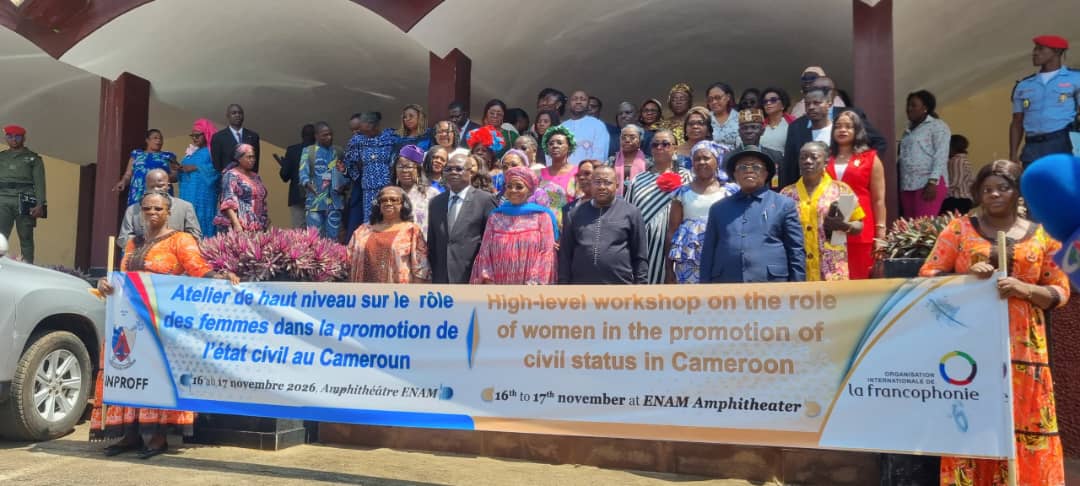
The Ministry of Women’s Empowerment and the Family – MINPROFF convened a high-level workshop in Yaounde on November 16, 2026, to spotlight the pivotal role of women in advancing civil status registration across Cameroon.
Held under the theme “The role of women in the promotion of civil status in Cameroon,” the forum brought together government officials, diplomatic representatives, including the International Organisation of La Francophonie – OIF in Central Africa, heads of national institutions such as ENAM and BUNEC, municipal leaders from REFELACAM and CVUC, and civil society actors.
Taking place just days before the anniversary of the United Nations Convention on the Rights of the Child, the workshop sought to build women’s capacity as community agents of change in popularising civil status laws.
Delivering the keynote address, the Minister of Women’s Empowerment and the Family, Prof. Marie Thérèse Abena Ondoua, underscored the urgent necessity to eliminate the phenomenon of undocumented or “ghost children,” framing it as a critical child protection and human rights issue. She noted that despite ongoing sensitisation campaigns on the Law of December 23, 2024, which introduced key reforms such as extended deadlines for birth declarations, the number of children without birth certificates remains alarming.
Citing the 2018 Demographic and Health Survey (EDSC) alongside municipal backlogs, the Minister revealed that 168,677 birth certificate applications submitted by mayors are currently awaiting approval at MINPROFF, requiring an estimated 1,686,770,000 CFA francs in funding.
Addressing the root causes of the low registration rate, Prof. Abena Ondoua attributed the crisis to a combination of socio-economic and domestic challenges.
“Among the causes that could explain this low rate of birth registration, include material and intellectual poverty of some parents, culpable neglect of their duties, the security crisis affecting certain regions, marital conflicts and breakup of cohabiting couples,” she stated. The Minister equally warned of the severe long-term toll on unregistered youths, noting that “the immediate consequence for children remains the issue of school dropouts and, later on, a shattered future, thwarted ambitions and a completely compromised sense of citizenship.”
To counter this trend, MINPROFF has rolled out targeted interventions, including mass and interpersonal communication drives to educate families on child protection laws, alongside direct financial grants to its divisional delegations and distressed municipalities to process birth certificates for vulnerable children.
However, the Minister emphasised that financial constraints require greater community-driven solutions, positioning women at the heart of the response. “Against a backdrop of scarce resources, the pursuit of efficiency in the efforts made and the active participation of communities in resolving the problems they face, the role of women in birth registration emerges as a beacon of hope in curbing the phenomenon of children without birth certificates in our towns and rural areas,” she explained.
Prof. Abena Ondoua highlighted that women’s unique societal position makes them natural champions for the cause, noting that beyond economic production, a woman brings life into the world and bears a primary responsibility for her children’s legal identity. She pointed out that Cameroonian women are already heavily mobilised through solidarity groups, associations, Common Initiative Groups – CIGs, and development cooperatives, urging stakeholders to harness this vast volunteer network to overcome parental resistance and missed legal deadlines.
Challenging the participants to step up as frontline advocates, the Minister issued a direct call to action. “Dear participants, you play a key role in birth registration. That is why I am asking you to take the lead in promoting birth registration in our towns and rural areas,” she urged, expressing confidence that the workshop’s deliberations would yield actionable recommendations “to improve birth registration and protect the best interests of our children, because a child without a birth certificate does not exist.”
The Minister also extended her appreciation to the International Organisation of La Francophonie for its sustained partnership with the Cameroonian government in safeguarding children’s rights and combating the “ghost children” crisis. Echoing the words of President Paul Biya during his May 8, 2002 address to the UN General Assembly, who affirmed that “there is no human cause more worthy than that of defending children, who, according to the Bible, are a gift from God”, Prof. Abena Ondoua expressed optimism that collaborative action would yield lasting results.
Concluding her address, the Minister reaffirmed the state’s commitment to working alongside women’s organisations and development partners to honour international child welfare benchmarks.
“The Government will continue to work with key stakeholders and to partner with you to make Cameroon a country that is more and more determined to live up to the commitments set out in Agenda 2040, in order to earn its place among the community of benevolent States that are contributing to make ‘Africa worthy of its children,’” she stated.