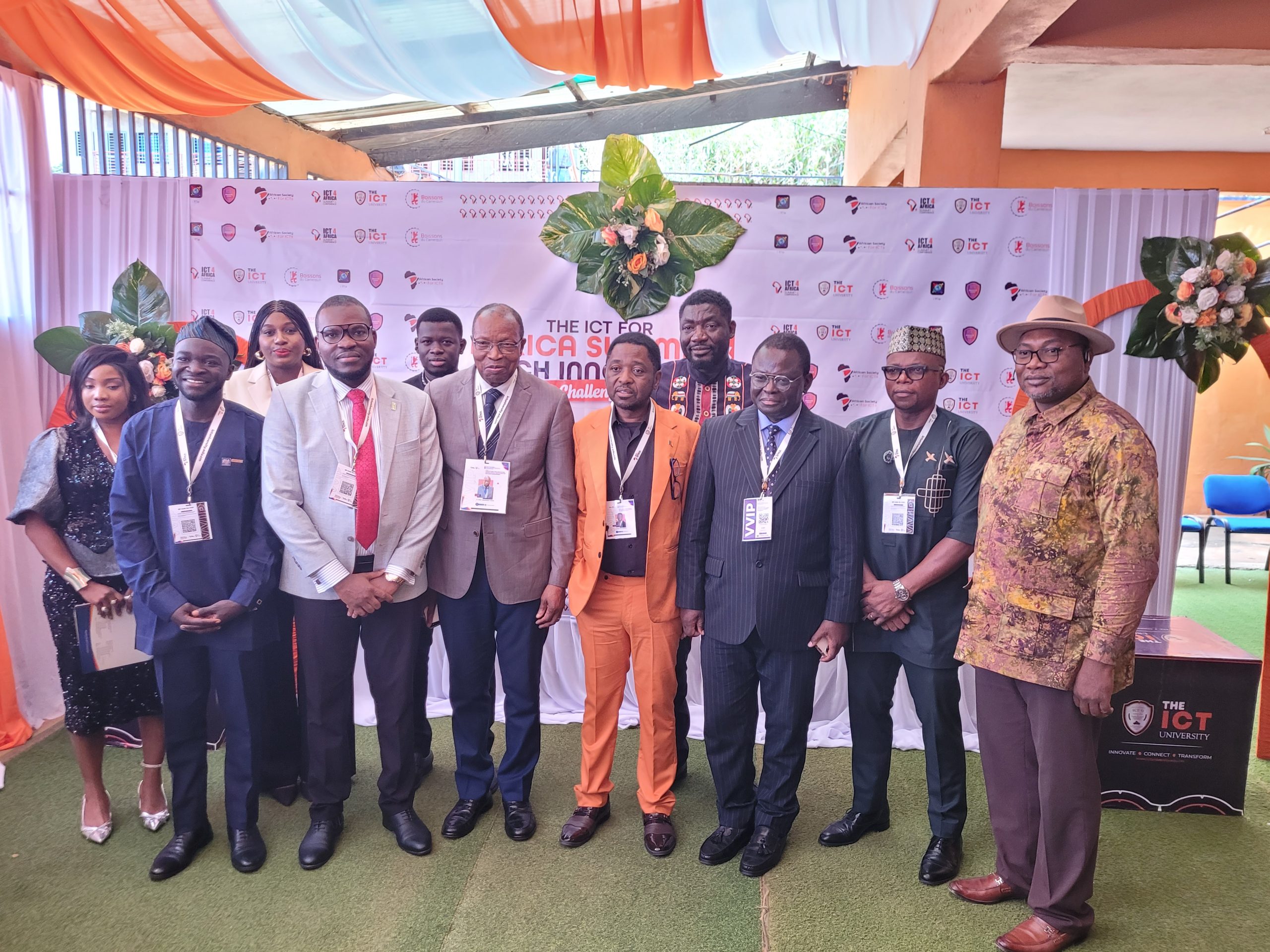
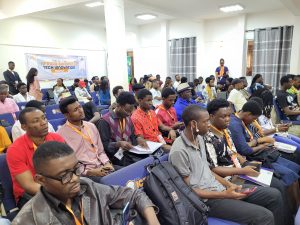
The 2026 edition of the ICT for Africa Summit and Tech Innovation Challenge officially kicked off on August 4, 2026, at the Emmanuel Pondi Auditorium of the ICT University in Yaounde.
Running through to August 7 under the theme “Africa’s Next-GEN Innovators: Driving Digital Innovation for Inclusive Development,” the three-day gathering brings together students, researchers, academics, public decision-makers, and digital experts. The opening ceremony featured a panoply of guest speakers and panelists amongst which Cybersecurity Expert Felix Fomemgia, Business Consultant Valentine Che and Executive Producer and Director Tatapong Beyala. It was equally attended by a host of university leaders and government officials, whose focus was on channeling youth creativity toward sustainable socio-economic growth.
In his opening address, Professor Victor Mbarika, Founding President of The ICT University, emphasized that the summit is far more than a simple academic conference. Instead, it serves as a strategic platform designed to enhance youth skills, foster collaboration across the digital ecosystem, and stimulate practical problem-solving. Transitioning from previous editions that focused primarily on discussion, Conference Chair Professor Foluso Ayeni noted that the 18th edition marks a decisive shift toward incubations, tangible outputs, and scalable enterprises.

Reflecting the expanding footprint of the summit, the flagship Tech Innovation Challenge has evolved significantly in both participant diversity and institutional reach. While earlier competitions primarily targeted high school students, the initiative has broadened its scope to encompass university-level innovators. Among the higher education institutions showcasing their projects this year are the University of Bamenda and the University of Dschang, alongside nearly fifty competing teams presenting prototypes and minimum viable products – MVPs.
The scope of solutions evaluated by the panel has also expanded to meet the continent’s diverse needs. The competition sectors have increased from three to four distinct verticals: Agriculture, Finance, Health, and Technology. By integrating digital health alongside fintech, e-agriculture, and ed-tech, the summit offers a more comprehensive platform for projects addressing critical infrastructural and societal challenges across Central Africa and beyond.
A primary highlight of the summit is the 3.5 million FCFA prize pool dedicated to rewarding the top-performing projects. However, organizers stressed that financial rewards are merely a launching pad. Professor Ayeni, Conference Chair pointed out that post-competition support, including long-term technical and entrepreneurial guidance, is vital to prevent viable projects from stalling. Mentorship structures will help student teams transform their localized concepts into scalable businesses capable of competing on a global scale.
Delivering the keynote address, Ousman Touray urged African youth to recognize their creative potential and discard reliance on foreign technical imports. He called on participants to design solutions with pan-African applicability, leveraging digital networks to collaborate across borders. Emphasizing the privilege of having access to institutional resources like those at The ICT University, the keynote speaker challenged the students to act as ambassadors for a new wave of regional tech entrepreneurship.
The Cameroonian government reasserted its commitment to nurturing the digital ecosystem through representation from the Ministry of Posts and Telecommunications – MINPOSTEL. Representing the Minister, Dr. NLEND Raphael, Technical Advisor N°1 highlighted MINPOSTEL’s ongoing efforts to establish an enabling environment for young tech creators. He noted that government support includes providing crucial infrastructure, funding avenues, incubators, co-working spaces, and structured mentoring to ensure these enterprise initiatives remain sustainable.
Ultimately, the 2026 summit underscores a growing consensus that Africa’s socio-economic trajectory relies heavily on its youth. Vice-Chancellor Professor Emmanuel Tonye described the gathering as a “technological Olympics,” where students gain the validation and resources needed to see themselves as true innovators.
By offering training, incubation, and direct industry linkage, The ICT University and its partners continue to build a pipeline of technology entrepreneurs ready to drive inclusive development across the continent.
Admissions are ongoing at The ICT University for the October 2026 Intake. Students have the possibility of studying in English or French, online or onsite. Apply before September 30, 2026 at ictuniversity.org/portal-sign-up https://studentportal.ictuniversity.edu.cm/portal-sign-up/.
For inquiries, the following numbers are available; +237 682 38 85 72 | +237 651 06 00 49.