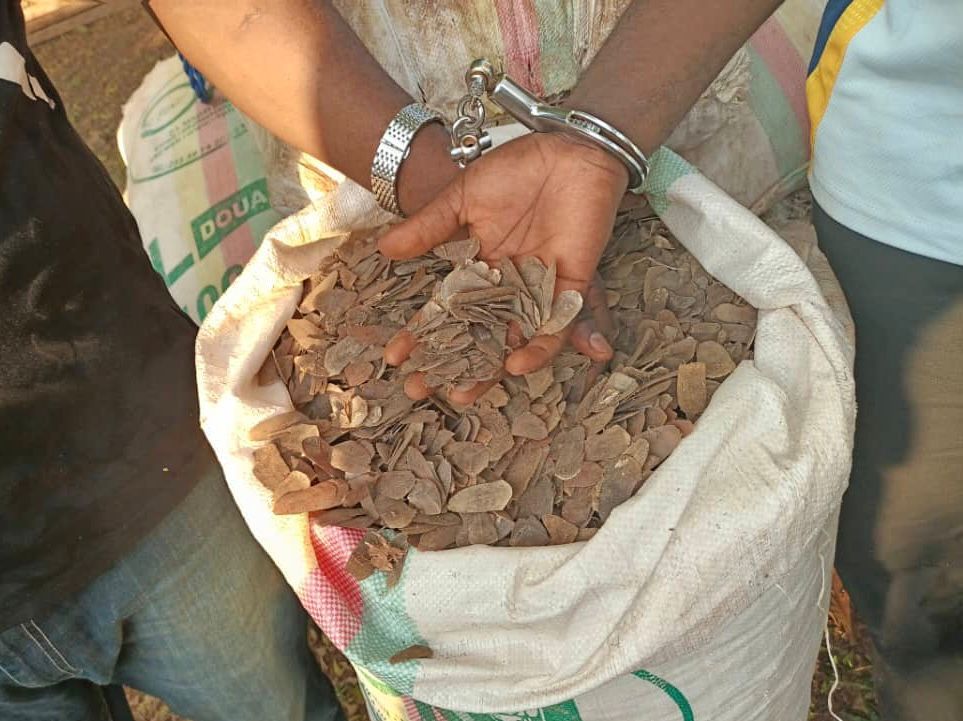
Three suspected wildlife traffickers are scheduled to face trial at the High Court in Yokadouma following a major anti-poaching crackdown that yielded over 700 kilograms of illicit pangolin scales.
The suspects were apprehended during a coordinated operation led by the Boumba & Ngoko Divisional Delegation of Forestry and Wildlife, alongside the Gendarmerie and technical partners from LAGA, a wildlife law enforcement support organization. Authorities confirmed the arrest dismantled a key node in illegal animal trade operations across the region.
Investigators revealed that the arrested individuals belong to an expansive transnational wildlife crime ring operating across Central Africa. The network’s reach spans Cameroon, Gabon, Congo-Brazzaville, the Central African Republic, and Equatorial Guinea.
To evade detection by law enforcement, the syndicate specialized in the illegal collection, stockpiling, and distribution of pangolin scales by disguising their illicit operations behind the legitimate trade of non-timber forest products.
The seizure underscores the severe ecological threat to pangolins, which remain the most trafficked mammals on the planet. Cameroon serves as a critical habitat for three distinct species: the white-bellied, black-bellied, and giant pangolins. All three species are currently listed as endangered on the International Union for Conservation of Nature – IUCN Red List, making large-scale seizures essential for preserving remaining wild populations.
In the wake of the arrests, Cameroon’s Ministry of Forestry and Wildlife issued a stern public statement condemning the illegal harvest as a “massacre of pangolins.” The Ministry reiterated its firm commitment to eradicating illegal wildlife commerce and protecting the country’s biodiversity through rigorous law enforcement and strategic inter-agency operations.
The case has been handed over to an examining magistrate in Yokadouma for thorough judicial investigation. If convicted under Cameroon’s updated 2024 Wildlife Law, the three suspects face stringent legal penalties, including up to 20 years imprisonment and court fines reaching up to 50 million FCFA.