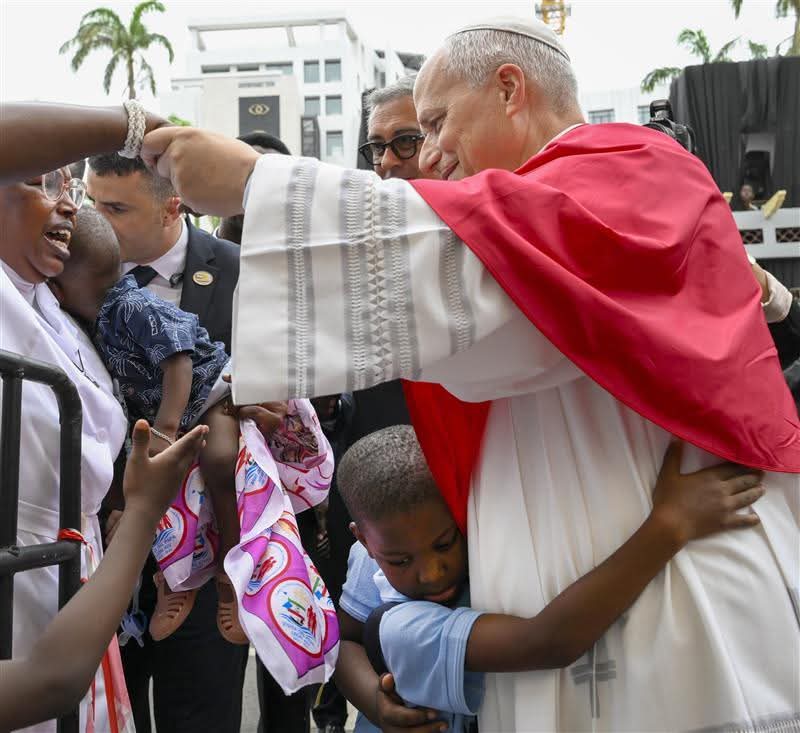
Pope Leo XIV concluded his 11-day Apostolic Journey across Algeria, Cameroon, Angola, and Equatorial Guinea with a series of powerful encounters that emphasized mercy, dignity, and the transformative power of faith.
At the Malabo Stadium, the Pontiff addressed 30,000 faithful, declaring that “the story of our lives finds meaning in the Gospel.” Reflecting on the biblical encounter between Philip and the Ethiopian eunuch, he illustrated how the Word of God serves as a source of liberation for the marginalized and oppressed, urging the Church to act as “good leaven” in society through service and solidarity.
In a stirring meeting at Bata Stadium, the Pope focused on the continent’s future by engaging with young people and families. He championed a “culture of effort,” encouraging the youth to bypass the allure of easy success in favor of discipline and hard work. Addressing personal testimonies, he advocated for the dignity of women in the workplace and the sanctity of the family, which he described as an “exciting journey of holiness.”
His message was clear: a life rooted in Christ is the ultimate source of joy, capable of overcoming social prejudices and fostering a culture where every individual feels respected.
Perhaps the most poignant moment of the journey occurred during a visit to Bata Prison. Despite a sudden, heavy downpour, hundreds of inmates stood in the rain to hear a message of radical mercy. The Pope insisted that “no one is excluded from God’s love” and that a person’s life is never defined solely by their mistakes.
By gifting the inmates a statue of Saint Francis of Assisi—who found his own path to conversion while imprisoned—the Pontiff highlighted the potential for a fresh start, advocating for the rights of the incarcerated to study and work with dignity.
The spiritual depth of the visit was underscored by the Pope’s focus on the Eucharist as the “eternal Covenant” that sustains the faithful through life’s deserts. He linked ancient promises to modern realities, calling on the local Church to make the proclamation of salvation visible through tangible actions of forgiveness and justice. Even in moments of grief, such as the sudden passing of Fr. Fortunato Nsue Esono, the Pope urged the community to remain steadfast in faith, seeking clarity and peace rather than speculation.
As Pope Leo XIV departed from Malabo International Airport for Rome, he left behind a vision of an inclusive and resilient African Church. His final exhortation challenged the people of Equatorial Guinea and the wider continent to become active witnesses of charity.
By bridging the gap between the sacred text and the “book of history,” the Pontiff’s visit aimed to ignite a future of hope anchored in the light of Christ, ensuring that the marginalized, the young, and the imprisoned are never forgotten in the journey toward national and spiritual renewal.