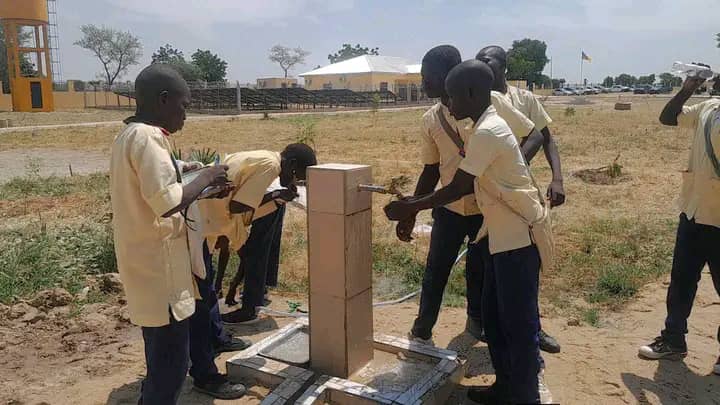
A major commitment to education and local development has materialized in the locality of Piwa, situated within the municipality of Kaélé, Mayo-Kani division.
This transformation was highlighted on October 27, 2026, during an evaluation visit by a high-level joint delegation assessing the achievements of the Local Governance and Resilient Communities Project – PROLOG.
Led by Prof. Tcheuwa, Inspector General at the Ministry of Decentralization and Local Development – MINDEVEL, the mission included World Bank representatives, national PROLOG team leader Dr. Jackson Ngwa Edielle, and Prof. Haman-Djalo, President of the Far North Regional Council, alongside local administrative authorities.
The fruit of a powerful synergy between the Regional Council and PROLOG with financial backing from the World Bank, the Technical, Industrial, and Commercial High School – CETIC of Piwa has quickly established itself as an educational hub of excellence.
The modern facility comprises an administrative building, four classroom blocks, specialized technical workshops, and a pedagogical kitchen. Designed to accommodate up to 800 students, the campus currently serves nearly 300 learners, including 127 young girls, providing them with tangible career prospects and professional futures within their own communities.
Beyond its immediate local impact, these investments reflect the growing strength of local governance across the entire Far North region. PROLOG’s overarching progress report highlights 186 funded projects totaling nearly 7.8 billion CFA francs, boasting an impressive execution rate of 96 percent completed and accepted operations across 16 beneficiary municipalities. Meanwhile, the Far North Regional Council has successfully mobilized 3.2 billion CFA francs to deliver 16 structural infrastructures, with eight new projects valued at 6.4 billion CFA francs currently on the horizon.
Ultimately, the success of the CETIC of Piwa underscores decentralization’s proven capacity to sustainably reshape the socio-educational landscape and foster inclusive regional development.
Witnessing the tangible impact on local populations, the head of the World Bank delegation expressed strong satisfaction with the successful completion of these works, cementing the essential role of territorial communities in building long-term resilience.