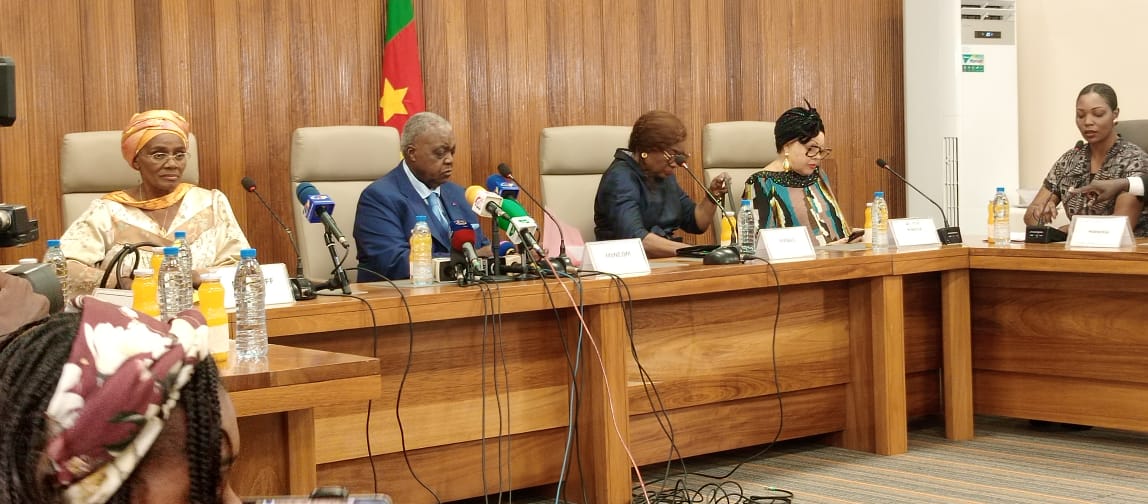
In response to the numerous sexual violence and child abuse perpetuated on the Cameroonian youth, with the most recent one being the alleged rape of three-year-old Pauline Joyce Nawal, a high-profile joint press conference was convened on June 1, 2026, in the auditorium of the Ministry of Communication. It brought together key government officials to address the alarming surge in extreme violence across Cameroon.
Spearheaded by Communication Minister René Emmanuel Sadi, alongside the Minister of Women’s Empowerment and the Family – MINPROFF, Marie Thérèse Abena Ondoa, and the Minister of Social Affairs – MINAS, Pauline Irène Nguene, the convention signaled a united state front. The high-level panel, which also included the Secretary General of Basic Education, Asheri Kilo aimed to inform public opinion, shatter cultural taboos, and outline aggressive state interventions against the brutal wave of child murders, abductions, rapes, and femicides fracturing Cameroonian communities.
Attendees of this conference included security officials, civil society representatives, and media professionals. Official data presented at the conference underscored a harrowing upward trajectory in gender-based violence – GBV and crimes against minors. MINPROFF recorded 1,599 cases of national violence between January and April 2026 alone, including 166 rapes, 50 femicides, and 13 infanticides.
This continues a grim historical trend where documented femicides rose from 50 in 2023, to 67 in 2024, and approximately 77 in 2025. Authorities emphasized that these numbers merely represent the visible tip of an underreported iceberg, as fear of social stigma and retaliation silences many victims.

Crucially, investigations reveal that the vast majority of these heinous crimes—such as the recent tragic sexual abuse of three-year-old Pauline Joyce in Yaoundé or the murder of young Mathis by a neighbor—occur inside the family circle or within trusted neighborhood boundaries, turning domestic spaces into danger zones.
In response, the government is executing a multi-sectoral operational strategy focused on immediate victim support, community prevention, and institutional capacity building. The ministries of Women’s Empowerment and of social affairs have successfully operationalized ten regional anti-GBV taskforces linking social workers, healthcare professionals, and legal experts across all ten regions.
On the ground, the state has deployed a protective infrastructure featuring 43 specialized Child Desks and 28 Gender Desks within police and gendarmerie stations, alongside roughly 100 temporary “safe spaces” to provide emergency medical and psychosocial rehabilitation for survivors.
To streamline national tracking, the state is actively upgrading the 116 Child Helpline and the 1503 toll-free reporting hotlines, while partnering with UNICEF to roll out the secure Child Protection Information Management System – CPIMS+ to ensure standardized, ethical case management.
On the legislative and enforcement front, Cameroon is leveraging its strict criminal framework while actively evolving its statutory tools to guarantee absolute deterrence. Under the 2016 Penal Code and international treaties like the UN Convention on the Rights of the Child, the judiciary is handing down maximum punishments; this was recently demonstrated when a court sentenced a child murderer to death by firing squad following a neighborhood dispute.
To patch lingering systemic loopholes, the government is fast-tracking a comprehensive, standalone GBV bill designed to mandate swift emergency legal procedures for severe cases and eliminate the dangerous cultural practice of informal, “amicable” out-of-court settlements that shield criminals.
Simultaneously, permanent security patrols and specialized child-protection training are being scaled up within law enforcement units, particularly around vulnerable high-crime sectors and school districts.
Ultimately, the government issued a solemn, collective call to action, declaring child protection and the eradication of GBV a non-negotiable national cause. Acknowledging structural challenges—including limited intersectoral funding, prolonged judicial timelines, and active security crises in the Far North, Northwest, and Southwest regions—ministers insisted that sustainable solutions must target societal mindsets, physical abuse, and toxic verbal violence.
Moving past purely economic explanations for these atrocities, the state challenged families, traditional and religious authorities, academia, and the media to actively promote non-violent communication and break the silence protecting abusers. Invoking President Paul Biya’s historic United Nations address on the sacred duty of securing children’s futures, the panel emphasized that protecting human dignity is a collective moral imperative that requires the unyielding commitment of every Cameroonian.