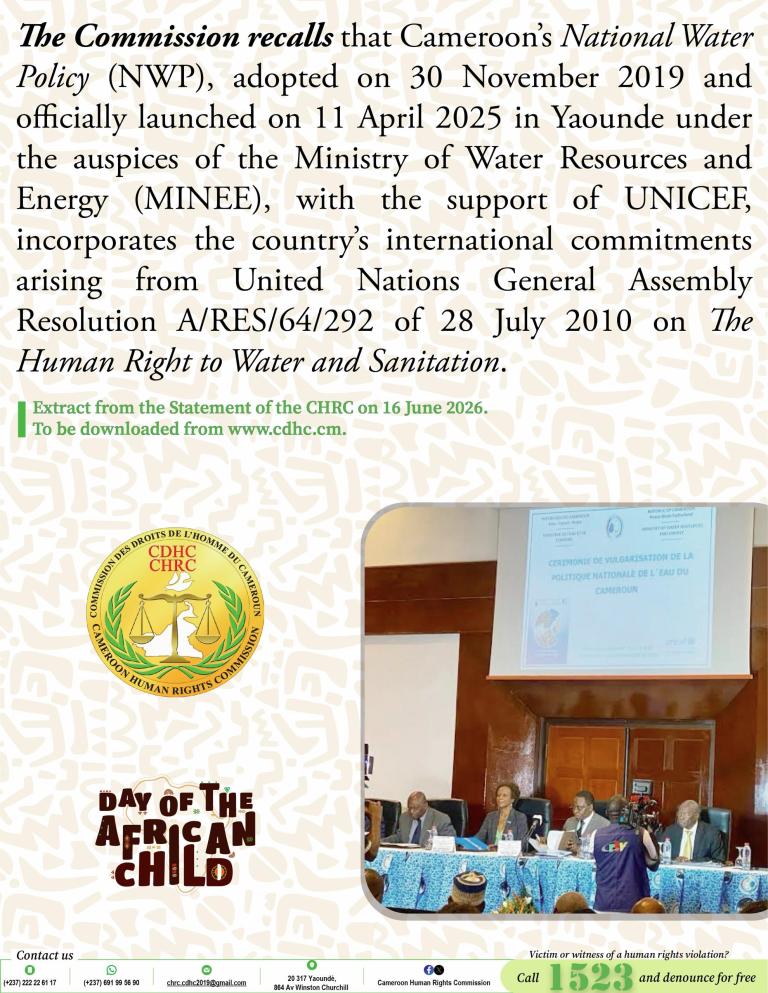
On the occasion of the Day of the African Child, celebrated on June 16, 2026, the Cameroon Human Rights Commission – CHRC issued a statement highlighting the challenges related to children’s access to water, sanitation, and hygiene, while calling for increased protection against the violence they face.
Centered around the theme “Ensuring universal access to Water, sanitation, and hygiene for every Child in Africa,” the 2026 edition highlights the vital role of these essential services in the effective realization of children’s rights. The CHRC emphasizes that access to clean water, sanitation, and hygiene is an indispensable condition for children’s health, dignity, and harmonious development.
The national human rights institution commends the efforts undertaken by public authorities and their partners, notably through the National Water Policy and the National Water Compact 2026-2030, which aims to accelerate universal access to safe drinking water and sanitation services in Cameroon.
However, the Commission laments the persistence of significant disparities.
According to the data cited in its statement, approximately 70% of the population has access to clean drinking water, with a stark gap between urban areas (82%) and rural communities (52%). Similarly, only 43% of Cameroonians have access to basic sanitation facilities, dropping to just 22% in rural areas.
Furthermore, the commission expressed deep concern over the resurgence of violence committed against children, including infanticide, filicide, female genital mutilation, and various forms of domestic violence. It strongly condemns these acts, describing them as grave violations of children’s fundamental rights.
The Commission highlighted recent initiatives led in collaboration with the ministries in charge of social affairs and the promotion of women and the family, which aim to strengthen protection mechanisms, support systems, and the prosecution of perpetrators of violence against women and children.
In its recommendations, the CHRC calls on the Government, Parliament, and the judiciary to rigorously enforce child protection laws and to ensure swift prosecutions as well as exemplary sanctions against perpetrators of abuse and crimes. It equally recommends that the Ministry of Social Affairs ensure the provision of water, hygiene, and sanitation infrastructure tailored for children with disabilities in all public institutions that accommodate them.
Through this statement, the Commission reaffirms that access to water, sanitation, hygiene, and protection from all forms of violence remains an essential condition for securing the well-being, dignity, and future of children in Cameroon and across Africa.