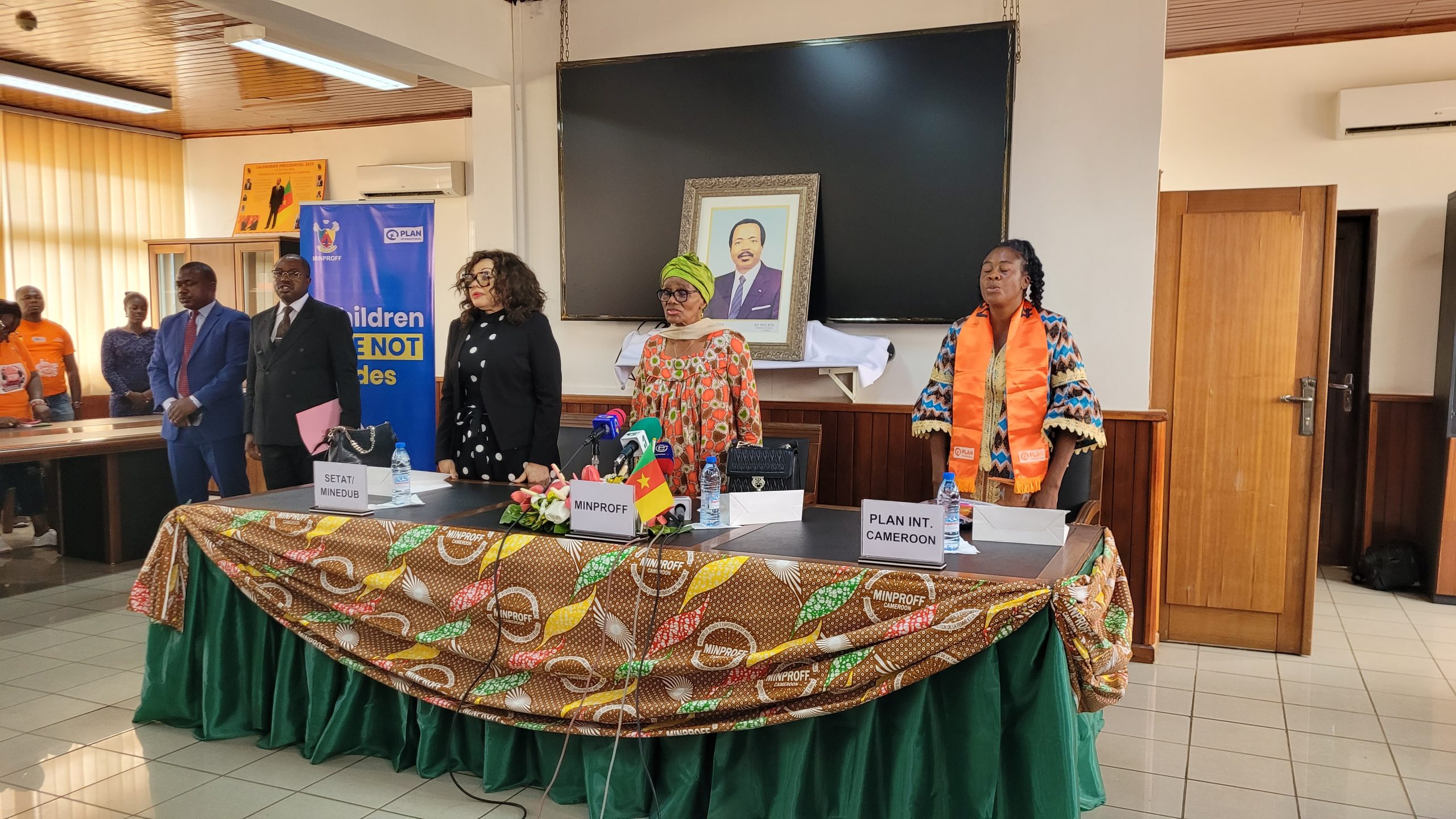
History will have it that, on November 27, 2026, Cameroon joined the international community in commemorating the very first International Day for the Elimination of Child, Early and Forced Marriage during a national press briefing at the annex office of the Ministry of Women’s Empowerment and the Family – MINPROFF.
Proclaimed by the United Nations General Assembly earlier in September 2026, the landmark event was co-organized by MINPROFF, the United Nations System, and Plan International Cameroon. High-level institutional mobilization underscored the urgency of the cause, bringing together the Minister of Women’s Empowerment and the Family, Marie Thérèse Abena Ondoua, the Secretary of State for Basic Education, Asheri Kilo, alongside representatives from the Ministries of Social Affairs and Posts and Telecommunications.
COMING UP AFTER THE ADVERTISEMENT
Addressing the press, Minister Marie Thérèse Abena Ondoua emphasized that ending child marriage is essential to protecting human dignity, fundamental rights, and the future of Cameroon. While millions of girls worldwide have their childhoods cut short before turning 18, the reality in Cameroon remains pressing, with nearly three out of ten young women married or living in cohabitation before adulthood.
The Minister stressed that child marriage must never be justified as a cultural tradition or an economic solution, as it strips girls of their education, exposes them to life-threatening early pregnancies, and traps them in cycles of poverty and dependence.
To combat this scourge, the Cameroonian government has rolled out several strategic initiatives despite persistent challenges in certain communities. Minister Abena Ondoua highlighted the updating and implementation of the National Gender Policy, the creation of a multisectoral national action plan to end child marriage, and the deployment of a positive parenting program.
Furthermore, a nationwide campaign on girls’ rights has already culminated in the adoption of a National Girls’ Agenda, while MINPROFF continues to operate its free, 24/7 toll-free child protection helpline (116) to report cases of abuse or attempted forced marriages.
Representing the Country Director of Plan International Cameroon, Ms. Mairou Yenji reiterated that sustainable change requires concrete investments in education, child protection, sexual and reproductive health, and the economic empowerment of families.
Drawing attention to the global report “Changing Her Forecast,” the briefing noted that crises, climate change inclusive, further exacerbate the vulnerability of young girls to early marriage. Plan International outlined three core objectives for the day: strengthening political accountability, amplifying girls’ voices with evidence-based solutions, and mobilizing public opinion for lasting collective action.
A central pillar of the advocacy effort is empowering young people themselves to lead the charge against harmful social norms. Ms. Yenji commended the Youth Engagement Platform and its member associations for the success of the “One Month, One Voice: Stop GBV” campaign. Over a 30-day period, the youth-led initiative reached more than 268,810 people and generated over 31,600 social media interactions, notably engaging an audience comprising over 60 percent men in conversations about ending gender-based violence and child marriage.
The human impact of the crisis was brought into sharp focus through the moving testimony of Ngassa Oliver Selena, a young advocate from Plan International’s Youth Engagement Platform. Reflecting on her own privilege to pursue an education and choose her career, Selena lamented that many of her peers are already married with multiple children by age 17.
Questioning how a nation can build a strong, independent future when its young women are forced to abandon their dreams, she delivered a poignant plea on behalf of Cameroonian youth: “Let me be a girl, not a wife. Let me be a child and not a mother.”
Both youth advocates and institutional leaders used the platform to issue an official appeal to the First Lady of Cameroon, Her Excellency Mrs. Chantal Biya. Speakers respectfully invited her to become the National Patron and Champion for the Girl Child and the Elimination of Child Marriage.
Organizers expressed confidence that building a broad national coalition under her patronage would unite government bodies, traditional and religious leaders, civil society, and development partners to amplify girls’ voices from north to south and east to west.
Ultimately, the press briefing served as a powerful call to action for every segment of Cameroonian society to stand as a protective barrier for young girls. Parents were urged to choose books and qualifications over premature marriages, while traditional and religious custodians were called upon to dismantle harmful social norms.
By investing in girls’ education and safeguarding their right to grow up free from coercion, Cameroon aims to ensure that every young girl can dream, learn, and thrive, because, as Selena reminded the nation, an educated girl means an entire Cameroon that rises.