During the third day of his Apostolic Journey to Cameroon, Pope Leo XIV presided over a massive gathering of over 120,000 faithful at the Douala Japoma Stadium.
Reflecting on the miracle of the multiplication of the 5 loaves and 2 fishes, the Pontiff emphasized that the true miracle lies in sharing rather than hoarding or strife. He urged the youth of Africa to reject violence and abuse, reminding them that Cameroon’s greatest treasure is not its vast natural resources, but its people and their values of faith, family, and hospitality.
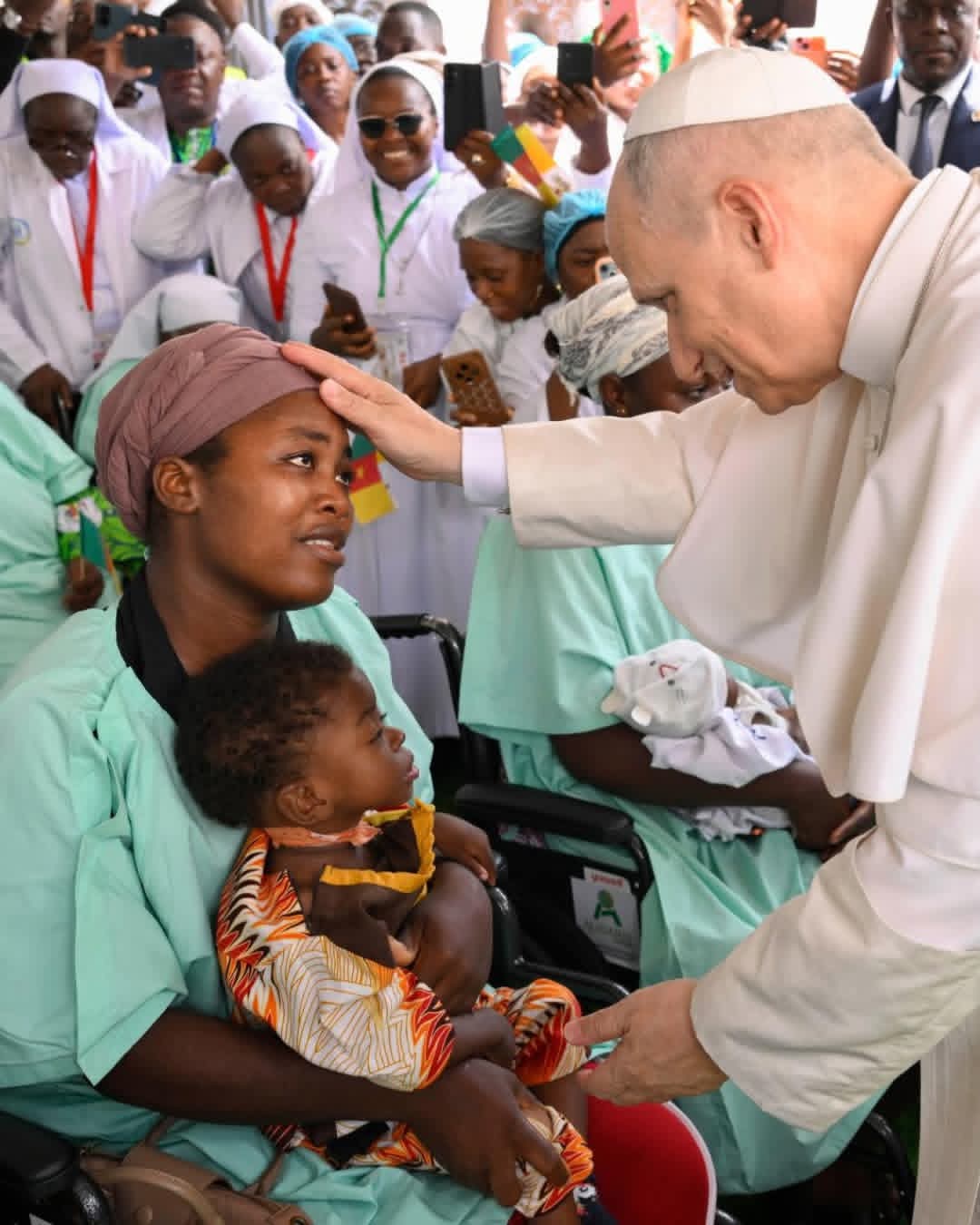
Following the Mass, the Pope demonstrated the message of care through a private visit to the Saint Paul Catholic Hospital, where He offered consolation to children and the elderly.
In the afternoon, the Holy Father traveled back to Yaounde to engage with the academic community at the Catholic University of Central Africa. He described the university as a “beacon” for the continent, essential for the pursuit of truth and the promotion of justice.
Pope Leo challenged the institution to be more than a center for technical knowledge, urging it to become a community where students and professors cultivate a “fraternity in knowledge.” He stressed that a nation’s prosperity depends fundamentally on upright consciences formed in truth, which serve as the only stable foundation for a just society.
Addressing the complexities of the modern era, the Pope warned against the decaying of moral values and the passive adaptation to dominant social paradigms. He specifically highlighted the “darker side” of environmental and social devastation caused by the global pursuit of raw materials, calling on the university to be a voice for humanity.
He encouraged young Catholics to become “pioneers of a new humanism,” urging them not to be afraid of “new things” but to approach them with a spirit of discernment that protects human dignity from being overshadowed by mere economic gain.
A significant portion of the Pope’s address focused on the rise of artificial intelligence and the digital revolution. He cautioned that while AI offers technical competence, it risks turning human relationships into functional interactions and trapping individuals in “bubbles” of isolation and polarization.
To counter this, he called for a robust humanistic formation that uncovers embedded biases and power structures. By strengthening the ability to discern, Catholic universities can ensure that simulation does not become the norm and that social bonds remain rooted in real, personal connection.
In his concluding remarks, Pope Leo XIV appealed to the “sons and daughters of Cameroon” to resist the urge to migrate and instead apply their education to the service of their own country. Quoting his predecessors, he reminded the audience that the Catholic university is “born from the heart of the Church” and exists to develop the whole human person, including their spiritual well-being.
He left the students with a mission to be protagonists of their own future, acting as leaders dedicated to the common good as he prepared for the final leg of his journey to Angola.