Pope Leo XIV began his historic apostolic journey to Africa on Monday, April 13, 2026, with a high-profile arrival in Algiers. Stepping off the papal plane, he was warmly received by the President of Algeria and the Apostolic Nuncio, signaling the start of an 11-day tour spanning Algeria, Cameroon, Angola, and Equatorial Guinea.
His first official act was a visit to the Monument of Martyrs, a site inaugurated in 1982 to honor Algerian independence. At the Djamaa el Djazair Conference Centre, the Pope addressed civil authorities and diplomats, urging the nation to resist “absurd polarizations” and instead foster “oases of peace” where human dignity remains inviolable.
The spiritual heart of the day centered on the Pope’s visit to the Grand Mosque of Algiers, the third-largest mosque in the world. Welcomed by Rector Mohamed Mamoun al Qasim, the Holy Father spent time in silent meditation, describing the mosque as a “divine and sacred space” where humanity seeks the presence of the Most High.
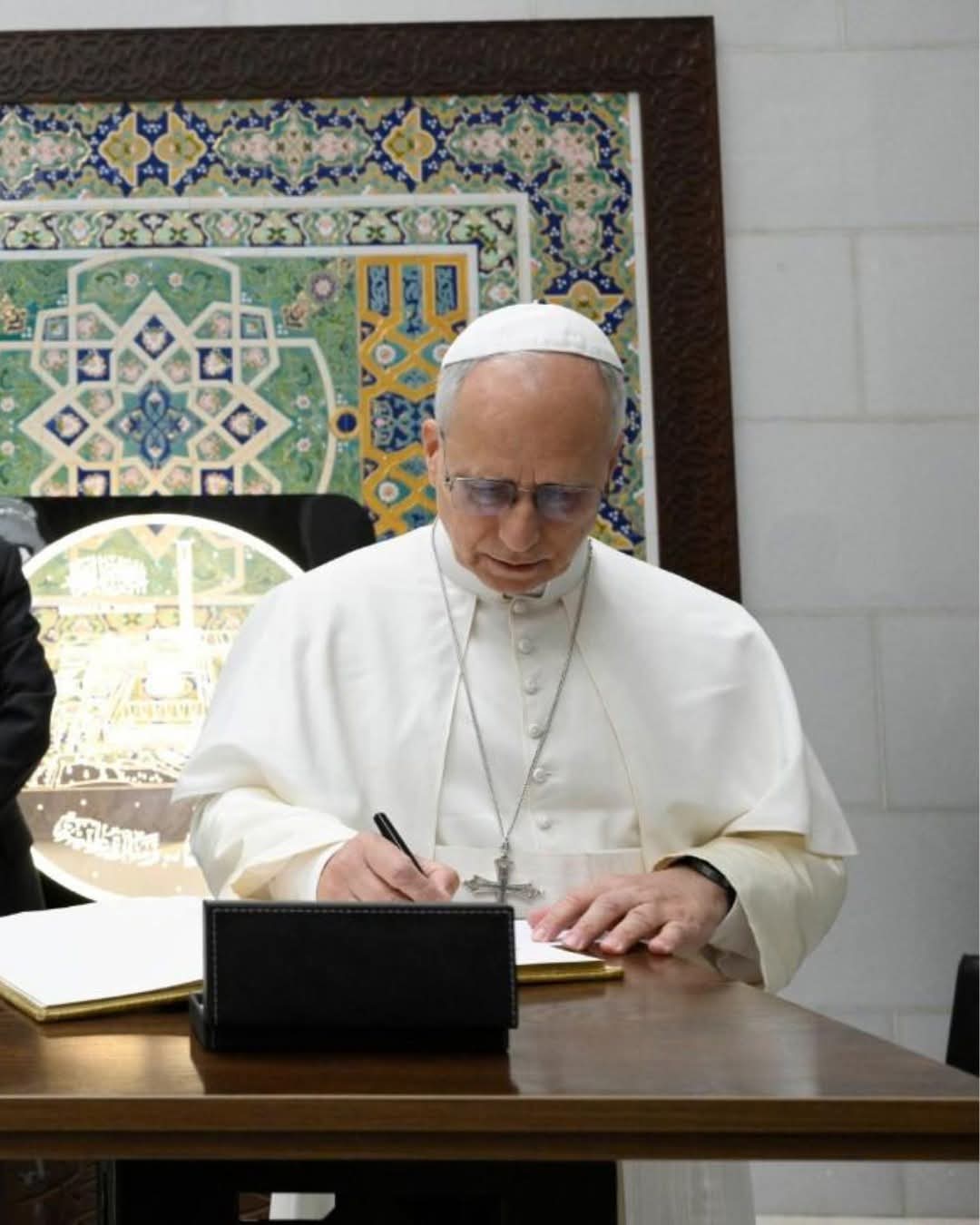
In his address, he paid homage to his “spiritual father,” Augustine of Hippo, and emphasized that seeking God necessitates recognizing His image in every person, regardless of their faith. Before departing, he signed the Book of Honour, praying for the mercy of the Most High to keep the Algerian people in peace and freedom.
Shifting his focus to the local Christian presence, Pope Leo XIV paid a poignant visit to the Missionary Augustinian Sisters in the Bab El Oued district. This private encounter was a tribute to the nineteen religious men and women—including sisters from this community—who were killed during the Algerian Civil War in the 1990s.
The Pope paused in prayer to honor these martyrs, whose “blood is a living seed,” and thanked the current sisters for their quiet, charitable work in education and hospitality. He encouraged them to maintain their “discreet and precious” presence as a sign of fraternity within the predominantly Muslim society.
The day’s events concluded with a vibrant gathering at the Basilica of Our Lady of Africa, where the Pope met with the wider Christian community. Expressing “profound joy and fatherly affection,” he reminded the faithful of their deep historical roots in North Africa, invoking the legacy of St. Monica and St. Augustine.
He urged the congregation to remain rooted in prayer, charity, and unity, serving as a bridge of reconciliation in a land marked by both ancient heritage and modern challenges.
Throughout this first day, Pope Leo XIV’s message was one of profound interreligious dialogue and mutual respect. By balancing state ceremonies with visits to both the Grand Mosque and the Basilica, he highlighted a shared responsibility to build a world where “peace, justice, and forgiveness” can flourish.
His activities underscored a commitment to healing the memories of the past while looking toward a future defined by the recognition of the dignity of every human being.
On this second day, Pope Leo arrived in Annaba and, despite the rain, was welcomed by two girls in traditional dress holding flowers as well as the Bishop of Constantine-Hippo and the Algerian ministers of foreign affairs and culture.
Going back to the lands walked by his spiritual father, St. Augustine, Pope Leo laid a wreath of flowers and planted an olive tree as a symbol of hope and peace. Pope Leo’s next stop was to the Ma Maison Care Home for the Elderly, run by the Little Sisters of the Poor, where he stressed that “God’s heart is torn apart by wars, violence, injustice, and lies.”
He equally stressed that “God dwells here,” noting that “wherever there is love and service, God is there.”
In his short address, he thanked the sisters and residents for their witness and presented them with a mosaic of the Risen Christ as a gift.