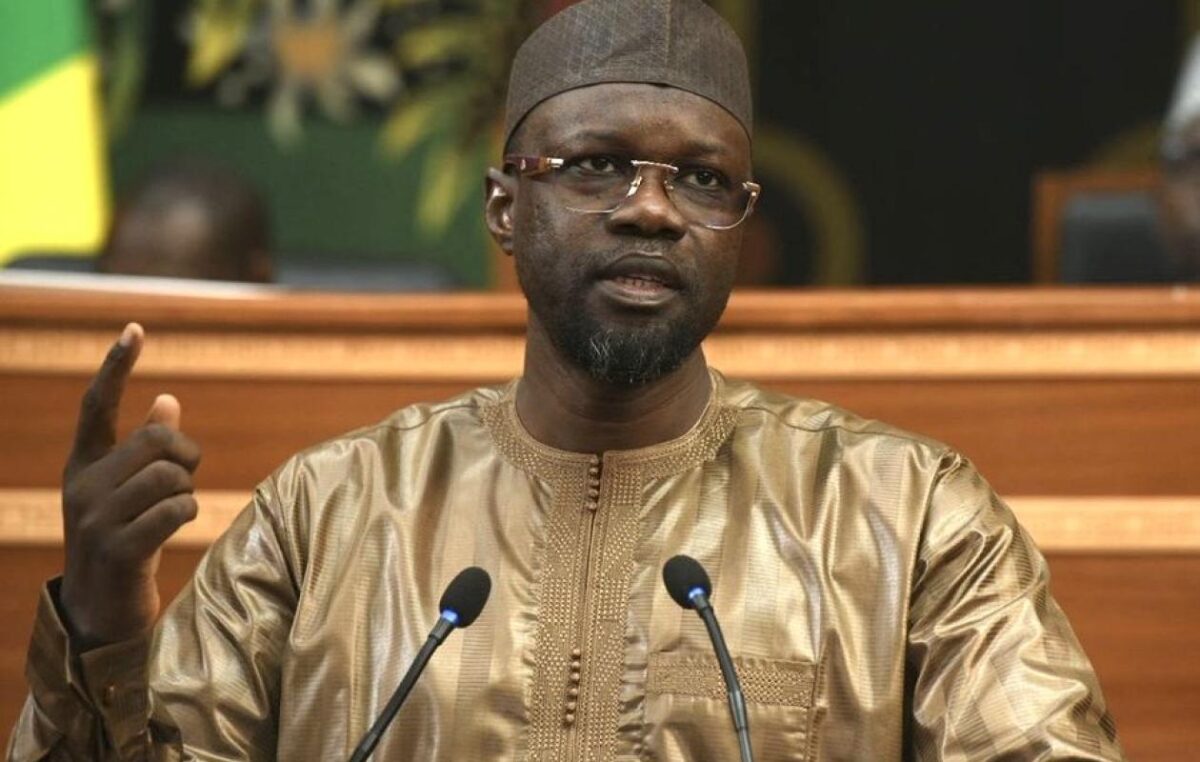
Senegal’s political landscape was upended on Tuesday, May 26, 2026, following a dramatic political comeback by former Prime Minister Ousmane Sonko, who was elected President of the National Assembly.
This swift development unfolded just four days after President Bassirou Diomaye Faye dismissed Sonko from his government, exposing a severe and rapidly growing rift within the ruling movement. Despite reported efforts by President Faye to block the process through the Constitutional Court, Sonko returned to parliament, was reinstated as a lawmaker, briefly installed as deputy speaker, and ultimately clinched the speaker’s chair during a special parliamentary session.
The election results underscored Sonko’s immense leverage, as he secured 132 votes from the 165-seat legislature, a victory heavily engineered by the ruling Patriotes Africains du Sénégal pour le Travail, l’éthique et la Fraternité – PASTEF party, which commands an overwhelming majority of 130 seats.
To pave the way for his ascension, the previous parliament speaker, El Malick Ndiaye, stepped down from his post. Meanwhile, Senegal’s opposition completely boycotted the voting session in protest, underscoring the deep polarization gripping the legislative body.
The rapid-fire maneuvering has triggered intense constitutional debate among legal experts and opposition figures, who have condemned Sonko’s return to parliament as flagrantly illegal. Critics argue his reinstatement violates Article 54 of the national constitution, which dictates that government membership is strictly incompatible with a parliamentary mandate, implying Sonko forfeited his legislative seat the moment he became prime minister.
Conversely, Sonko’s staunch loyalists reject this interpretation, maintaining that the law only bars the simultaneous execution of executive and legislative roles, and pointing out that the Constitutional Council had officially validated his election without any timely legal challenges.
This hostile political fallout marks a bitter collapse of the alliance between Faye and Sonko, who jointly rose to power in 2024. Friction had been mounting for months over a highly visible power struggle for state control, compounded by stark disagreements over economic policy and International Monetary Fund – IMF negotiations.
Tensions peaked after authorities uncovered misreported debt figures that inflated the country’s end-2024 debt burden to 132 percent of GDP, prompting the IMF to freeze a critical $1.8 billion lending program.
Believing President Faye was drifting away from PASTEF’s founding ideological agenda, Sonko had openly threatened to pull the party out of the government before he was axed and replaced by economist Ahmadu Al Aminou Lo.
With Sonko now firmly entrenched as the head of the legislature, he establishes a formidable political counterweight to President Faye’s executive branch, setting up a tense cohabitation at the apex of Senegalese power ahead of the 2029 elections.
As one of the most influential and popular figures in contemporary Senegalese politics, Sonko’s new institutional stronghold ensures he retains massive sway over the country’s legislative and economic trajectory, leaving the ruling movement fractured and the nation navigating uncharted political waters.