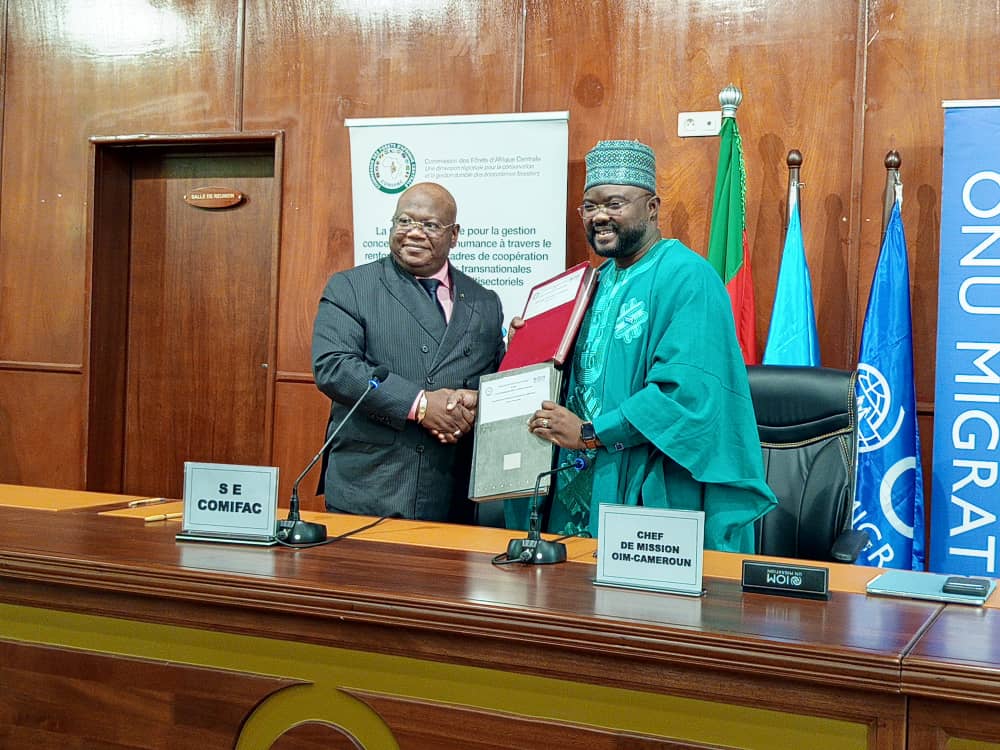
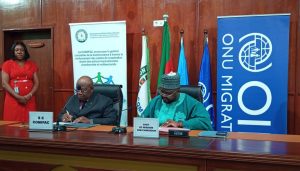
A pivotal shift in regional cooperation unfolded in Yaounde on August 14, 2026, as the International Organization for Migration – IOM Cameroon and the Central Africa Forest Commission – COMIFAC signed a historic Memorandum of Understanding – MoU.
Signed at COMIFAC’s headquarters alongside national consultations for Cameroon’s National Migration Policy, this strategic alliance targets the complex intersection of human mobility, climate change, and environmental degradation across the region.
The agreement directly addresses severe environmental stressors disrupting Central Africa, where northern Cameroon has witnessed a 25% drop in rainfall and coastal erosion recedes shorelines by up to 13 meters annually.
As climate shocks and localized conflicts force vulnerable communities to flee, vast forest ecosystems increasingly become primary places of refuge. Executive Secretary of COMIFAC, Hervé Martial Maïdou, and IOM Chief of Mission in Cameroon, Abdel Rahmane Diop, highlighted that sustainable migration governance is impossible without actively integrating forestry and environmental preservation into national strategies.
For COMIFAC, this partnership strengthens the implementation of its regional Convergence Plan. By embedding human mobility considerations into its framework, COMIFAC gains an institutional and legal baseline to support forest-dependent populations while safeguarding biodiversity.
Rather than viewing displaced communities as threats to natural resources, the alliance empowers COMIFAC to manage population flows sustainably, reducing deforestation and environmental strain in delicate Central African ecosystems.
For the IOM, partnering with COMIFAC bridges a critical gap between migration management and ecological protection. The agreement expands IOM’s operational reach into crucial forest landscapes, allowing the organization to establish data-driven approaches to track climate displacement. Furthermore, it enables IOM to promote sustainable, green economic opportunities for displaced youth and women, transforming environmental protection into a reliable engine for local livelihood generation.
Cameroon stands as an immediate beneficiary of this strategic alignment. As the nation actively develops its National Migration Policy with support from the European Union, the Ministry of Environment, Protection of Nature and Sustainable Development – MINEPDED, and the National Observatory on Climate Change – ONACC, this MoU ensures that climate adaptation and forestry management are core policy pillars.
The integration equips local authorities to better absorb climate-induced demographic shifts, manage resource competition, and foster long-term community resilience.
On a global scale, the IOM-COMIFAC agreement serves as a progressive blueprint for climate-responsive migration governance. By demonstrating how humanitarian, environmental, and regional bodies can unify their mandates, Central Africa offers a replicable model for other climate-vulnerable regions. It underscores the international imperative to treat migration not merely as a crisis of displacement, but as an integral factor in global ecosystem management and sustainable development.
Ultimately, this platform for joint action transforms forced mobility into structured resilience. By focusing on robust data collection, institutional alignment, and economic empowerment for youth and women, the IOM and COMIFAC are building a foundation where vulnerable communities can thrive alongside the vital forest ecosystems they inhabit.