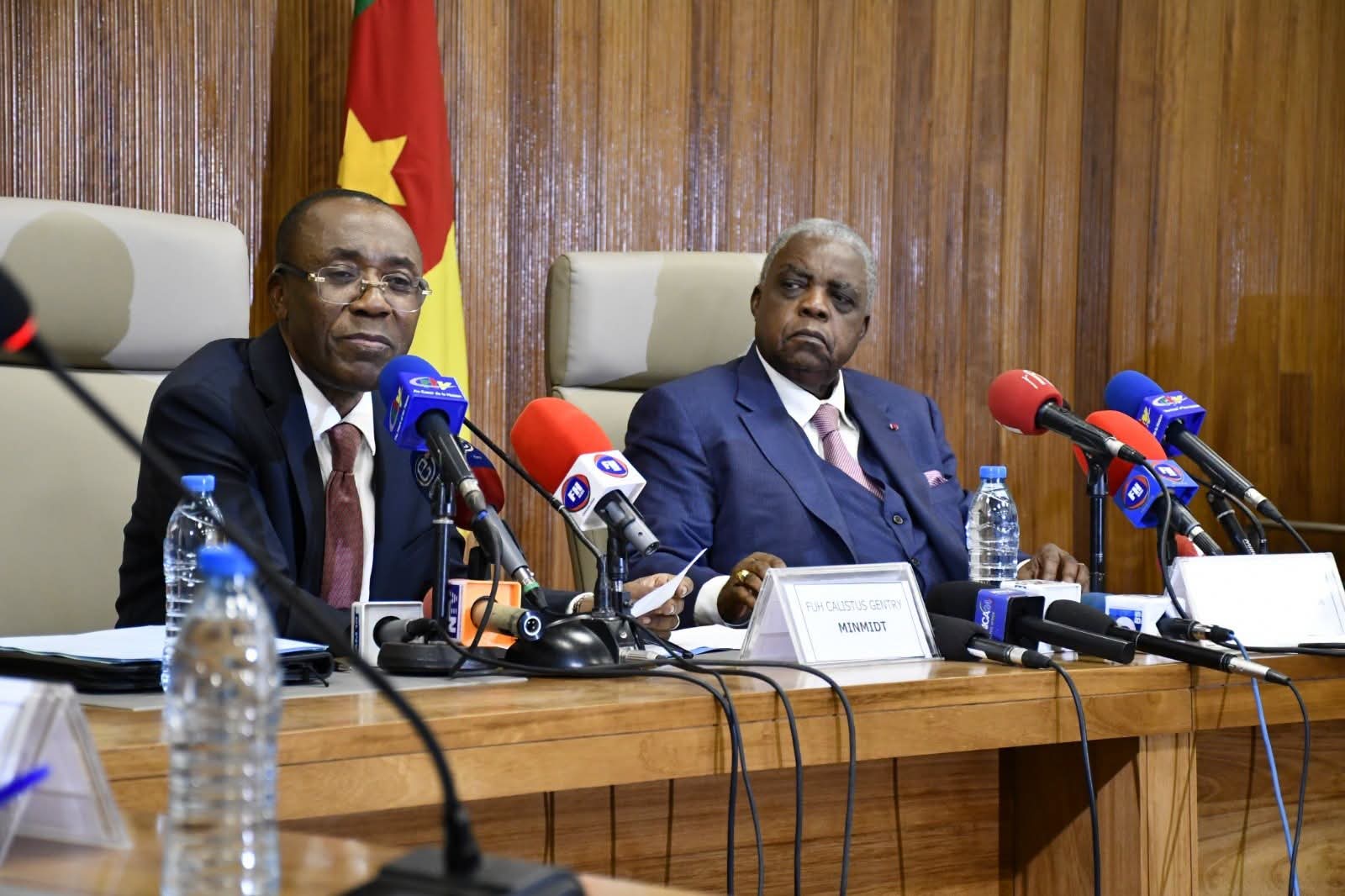
The interim Minister of Mines, Industry and Technological Development – MINMIDT, Professor Fuh Calistus Gentry, addressed the national and international press on July 15, 2026 alongside the Minister of Communication, René Emmanuel SADI.
The joint MINMIDT–MINCOM press conference, held at the auditorium of the Ministry of Communication, was organized under the theme: “The New face of Cameroon’s mining sector: The launch of major mining projects and the restructuring of the Gold Mining Industry.”
Opening the event, Minister Rene Sadi underscored the vital importance of the briefing as an official government communication designed to inform the public about the strategic and transformative direction of the country’s mineral sector.
In his keynote address, Professor Fuh Calistus Gentry announced that 2025 marked a historic turning point, with Cameroon officially joining the ranks of mining-producing nations. This milestone follows the successful commissioning of five major industrial mining operations across the country.
These landmark initiatives include the Bipindi–Grand Zambi Iron Ore Project, the Kribi–Lobé Iron Ore Project, the Minim-Martap Industrial Bauxite Project in the Adamawa Region, the Bidzar Industrial Marble Project, and the Colomine Gold Project, all of which are poised to drive nationwide economic growth.
Shifting the focus to the restructuring of the gold mining industry, the Minister presented a comprehensive government reform agenda anchored firmly in the provisions of the country’s new Mining Code.
The updated regulations introduce a stringent legal framework specifically designed to improve governance, enhance corporate transparency, and maximize national economic benefits. A major highlight of these changes is a strong emphasis on environmental protection, underscored by a new mandatory 63 million CFA Franc environmental rehabilitation bond required for each active mining site.
To empower local communities and promote domestic participation, the government is also introducing strict ownership rules for semi-mechanized mining operations. Under the new enforcement guidelines, Cameroonian nationals must hold a minimum of 51% of the share capital in any company applying for semi-mechanized mining permits. This indigenization policy is backed by a robust fiscal regime that features a 25% final mining composite tax, a 5% export duty, and a 1% mandatory financial contribution dedicated directly to the Mining Policy Implementation Fund.
Furthermore, the operational dynamics of gold extraction have been tightly standardized to boost national output and accountability. The ministry has established mandatory minimum monthly production thresholds based on equipment capacity, requiring 5 kilograms for sites operating 15 bowls, 7 kilograms for 20 bowls, and 10 kilograms for 30 bowls.
Alongside these production quotas, all mining operators have been given a strict six-month deadline to migrate entirely to closed-circuit leaching technology, a much cleaner and more environmentally sustainable mineral processing system.
According to the Minister, these holistic structural reforms are aimed at fully restoring state authority over the mining sector, strengthening mineral traceability, and aggressively combating financial fraud. By promoting responsible and modern mining practices, the government intends to ensure that Cameroon’s vast mineral wealth generates greater tangible value for its citizens while preserving the environment for future generations.
The press conference concluded with remarks by the Minister of Communication, who thanked the media for their robust participation and reaffirmed the state’s ongoing commitment to transparency and strategic engagement.