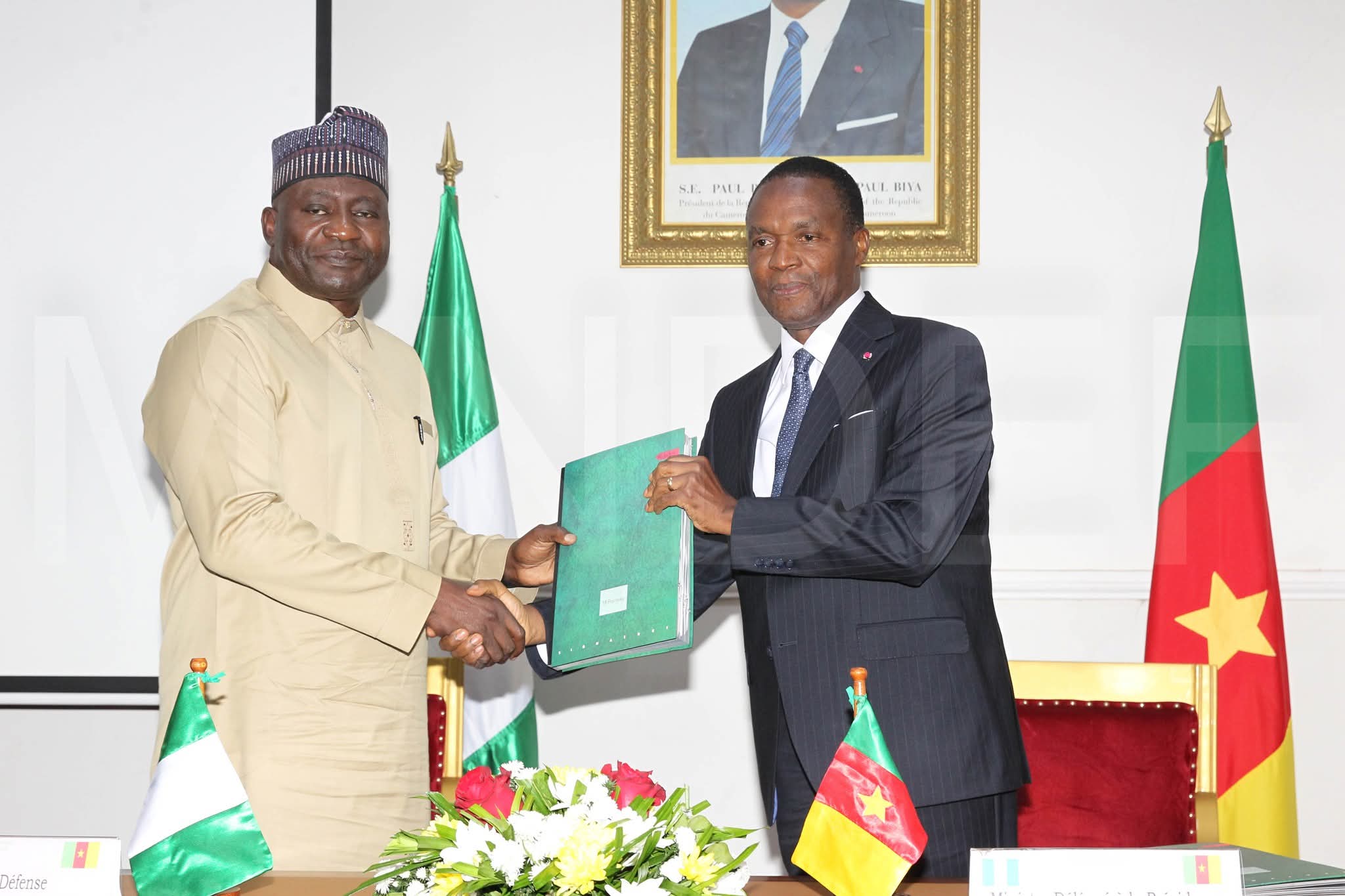
Cameroon and Nigeria strengthened their bilateral relations on June 16, 2026 through the signing of a comprehensive Memorandum of Understanding – MoU which focuses entirely on defense cooperation. The official signing ceremony took place in the Hall of Acts at the Ministry of Defense in Yaounde, Cameroon.
The document was paraphared by Cameroon’s Minister Delegate at the Presidency in charge of Defense, Joseph Beti Assomo, and Nigeria’s Minister of Defense, General Christopher Gwabin Musa, acting under direct instructions from Presidents Paul Biya and Bola Ahmed Tinubu.
The high-profile event drew a significant gathering of top-tier dignitaries, highlighting the strategic importance of the accord for both West and Central Africa. Attendees included members of the Cameroonian government, representatives from the international diplomatic corps, the Secretary-General of the Ministry of Defense, and a delegation of high-ranking military commanders led by the Major General of the Armed Forces Joint Staff. The proceedings commenced with the playing of both national anthems before transitioning into the formal signing and exchange of the official documents.
This defense pact is the direct result of extensive, collaborative dialogue aimed at addressing volatile security challenges that plague their shared borders. For years, both nations have grappled with overlapping cross-border threats, including militant insurgencies, smuggling networks, and piracy in the Gulf of Guinea.
The agreement formalizes a mutual commitment to dismantle these threats by pooling military resources and establishing robust, predictable frameworks for joint operational deployment.
A central pillar of the newly signed memorandum is the drastic expansion of real-time intelligence sharing and tactical coordination mechanisms. During their addresses, both defense ministers emphasized that traditional, isolated security strategies are no longer sufficient to counter highly adaptive transnational criminal networks. By synchronizing their border patrols and communication networks, the two militaries intend to eliminate safe havens along the frontier, ensuring a faster, more unified response to security breaches.
Beyond its immediate military application, the agreement is viewed by both delegations as a foundational requirement for economic prosperity and regional development. Secure borders are essential for maintaining steady bilateral trade corridors that support millions of citizens in both countries.
The ceremony wrapped up with a traditional group photograph on the esplanade of the Ministry of Defense, signaling a renewed era of diplomatic unity, mutual trust, and stability for the entire sub-region.