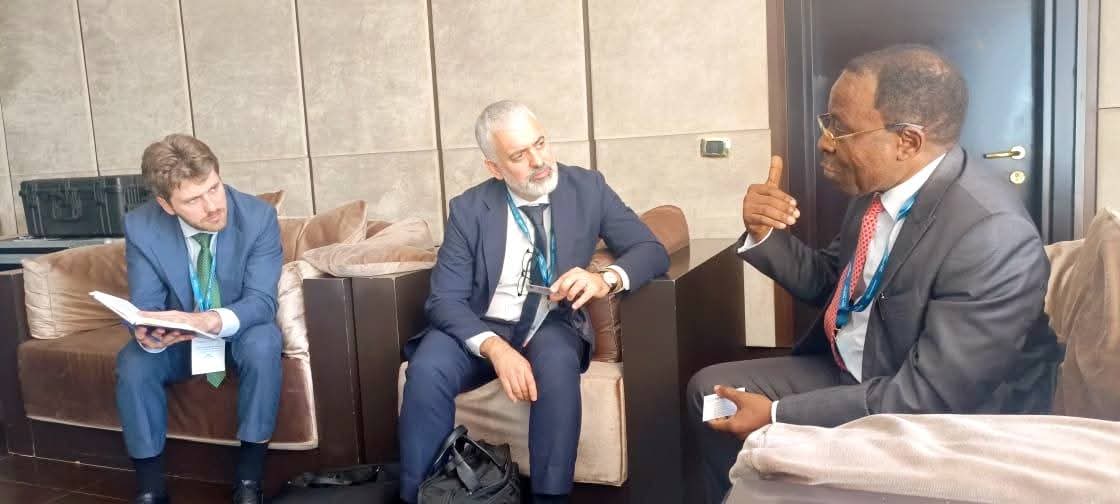
On the sidelines of the second day of the African Water Forum in N’Djamena, Cameroon’s Minister of Water Resources and Energy, Gaston Eloundou Essomba, spearheaded high-level B2B meetings with world-renowned water and sanitation corporations.
These strategic discussions align with the Cameroonian government’s broader agenda to mobilize top-tier international expertise to restructure its national water sector. Ultimately, the country aims to leverage these global insights to overhaul its public utilities, accelerate infrastructure development, and guarantee universal access to clean drinking water for all its citizens.
To address water security in rural and arid regions, Minister Essomba first met with Vergnet Hydro, a pioneer in off-grid drinking water solutions. The company showcased its innovative solar-powered conversion systems, which replace costly and environmentally taxing generator-driven water pumps, drawing on successful implementations in Burkina Faso, Guinea-Bissau, and Uganda. Vergnet Hydro also presented a sustainable business model focused on empowering local Cameroonian startups and operators through targeted technical, legal, and institutional support.
Turning to urban utility management, the Minister engaged with Eranove, a pan-African utility specialist famous for helping Côte d’Ivoire achieve a world-class 85% water network efficiency rate. Minister Essomba outlined Cameroon’s three main pillars for urban water reform: improving network yield, boosting billing collection, and expanding the overall subscriber base. Eranove shared its proven anti-fraud methodologies and operational tactics, offering valuable lessons on how Cameroon can curb utility losses and modernize its urban distribution.
Finally, discussions with global giant Suez centered on refining customer database management and implementing network sectorization to drastically reduce water loss, echoing Suez’s success in Senegal where network efficiency exceeds 80%. Suez, which has already contributed to Cameroon’s infrastructure through the Batchenga water treatment plant under the Yaounde water supply project – PAEPYS, expressed a strong interest in guiding Cameroon’s upcoming sector reforms.
Collectively, these strategic B2B sessions have provided Cameroon with a clear, actionable roadmap to modernize its public utilities through renewable energy, professionalized local operations, and robust sector governance.