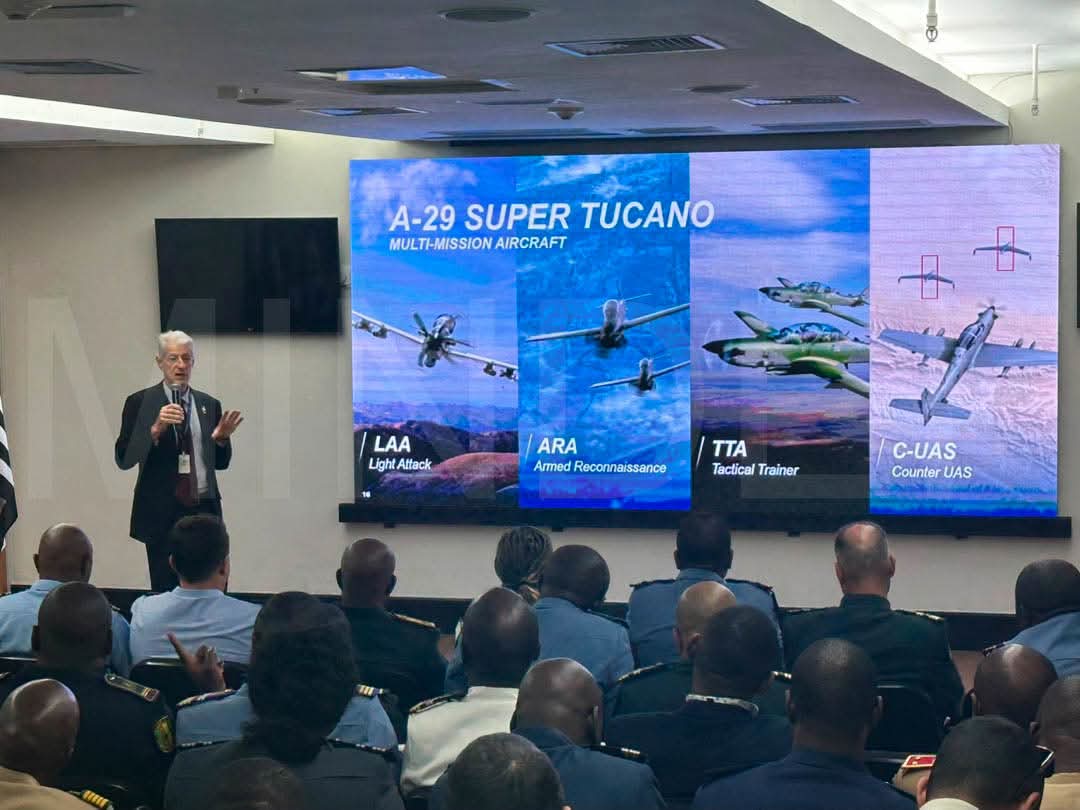
As part of an ongoing international study mission to Brazil, the 21st Class of the Simbock International War College – ESIG dedicated an intensive day to exploring the global aerospace hub of São José dos Campos.
Recognized as the nation’s aviation capital, this unique ecosystem seamlessly fuses advanced education, scientific research, and cutting-edge industrial manufacturing. The Cameroonian defense delegation split their high-profile visit between the Department of Aerospace Science and Technology – DCTA in the morning and the global headquarters of EMBRAER in the afternoon, analyzing how state-backed innovation fuels national sovereignty.
The morning session at the DCTA, hosted by its Vice-Director, introduced the student officers to an institutional history dating back to the 1940s. Inspired by the Massachusetts Institute of Technology’s “Smith Plan,” the DCTA was founded on the fundamental principle that building a domestic aviation industry requires first cultivating elite engineering talent. Operating from an iconic campus designed by the legendary architect Oscar Niemeyer, the institution drives technological breakthroughs for the Brazilian Air Force by utilizing the “triple helix” model—a collaborative framework linking the State, academia, and industry. It was directly out of this highly synchronized ecosystem that the aerospace giant EMBRAER was born in 1969.
In the afternoon, the delegation transitioned to EMBRAER’s headquarters to witness the practical application of this academic foundation. As the world’s third-largest commercial aircraft manufacturer and the global leader in the under-150-passenger airliner segment, the facility offered the military officers an up-close look at an incredibly complex industrial chain. The group toured active assembly lines, advanced paint shops, and the flight-test facilities of the renowned E-Jets commercial aviation unit.
Beyond its industrial dominance, EMBRAER highlighted its robust social footprint through the EMBRAER Institute, which celebrates its 25th anniversary in 2026 and has provided free, high-quality secondary education to over 5,500 public school students.
This pivotal exchange vividly demonstrated to the ESIG delegation how strategic synergy between scientific research, rigorous engineering, and industrial execution can build a completely self-reliant aerospace sector.
For the visiting officers, the Brazilian model offers an inspiring blueprint for developing a sovereign defense technological and industrial base back home. Ultimately, the immersive visit marks another successful milestone in deepening the strategic bilateral cooperation and knowledge-sharing between Cameroon and Brazil.