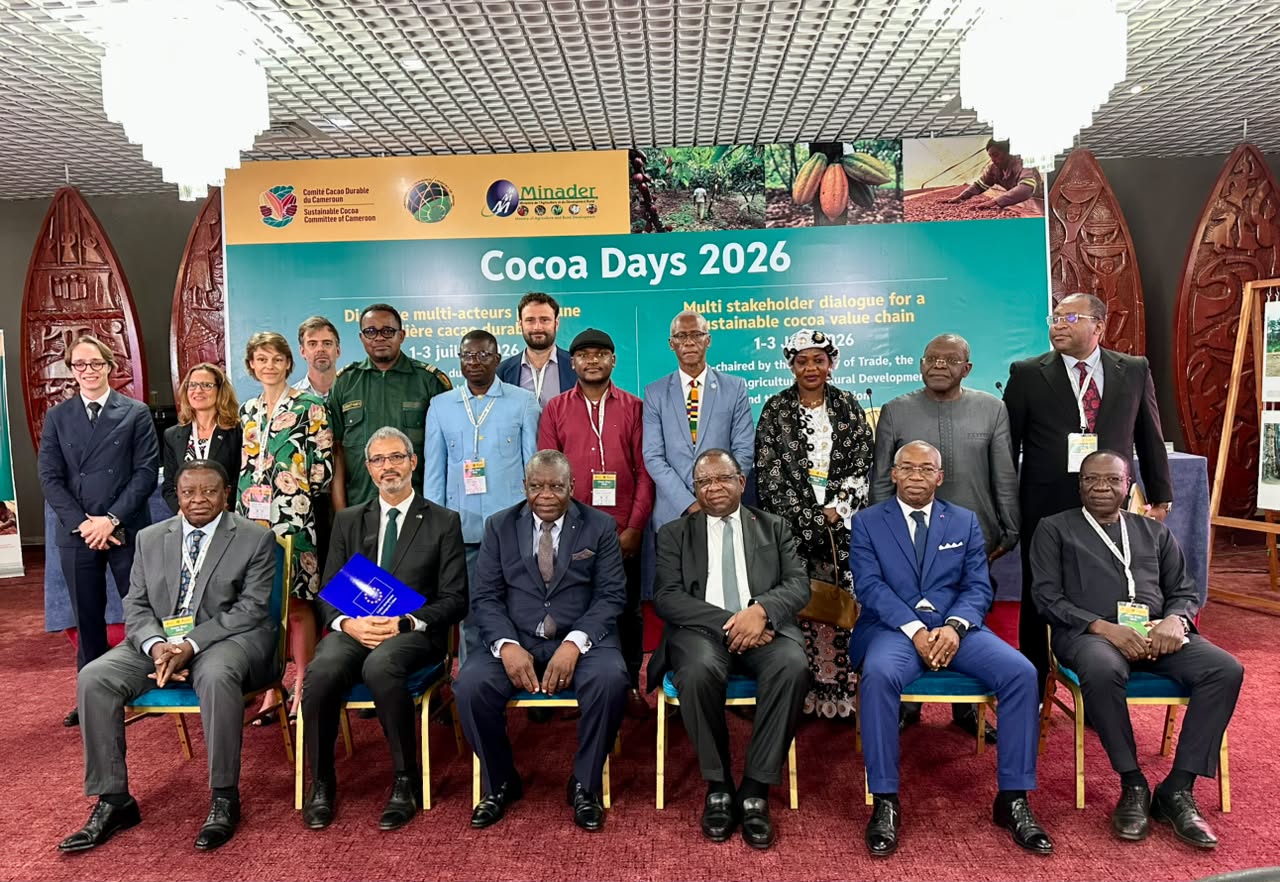
The maiden edition of the “Cocoa Days” multi-stakeholder dialogue officially opened this Wednesday at the Mont Fébé Hotel in Yaounde, aiming to overhaul Cameroon’s cocoa supply chain.
Chaired by Minister of Trade Luc Magloire Mbarga Atangana, alongside ministers of agriculture and forestry, the three-day event brought together major international development partners like the European Union – EU and global chocolate giants including Cargill, Barry Callebaut, and Touton.
The initiative marks the latest phase in a decade-long process that began in Brussels in 2017, designed to align Cameroon—where cocoa is the second-largest export earner after oil—with strict new global sustainability standards.
While institutional partners like the EU reaffirmed their commitment to supporting Cameroon’s cocoa ambitions, the opening ceremony was dominated by Minister Mbarga Atangana’s blunt assessment of the industry.
The Minister sounded a sharp alarm over the structural inequalities plaguing the market, noting that nearly ten years after Cameroon first brought farmer compensation to the negotiating table, the issue remains entirely unresolved. He fiercely criticized global price volatility, stating that a recent, brief surge in prices had quickly evaporated, leaving local farmers “at their wits’ end” and facing payouts that fall far below any baseline of decency.
A central flashpoint of the summit is the European Union Deforestation Regulation – EUDR, a strict environmental policy that has sparked heavy anxiety among local growers. While acknowledging that preserving the environment is a noble and non-negotiable cause, Mbarga Atangana pointed out that Cameroonian farmers have forced themselves to comply with these rules with very little to show for it.
He warned that the lack of financial return has led many vulnerable producers to view the sweeping international environmental mandates as a form of “punitive ecology,” where the financial burden of conservation falls entirely on the poorest link in the chain.
The primary objective of the “Cocoa Days” is to solve this exact, complex equation by bridging the gap between green mandates and economic survival. Over the course of the summit, regulatory bodies, farming cooperatives, and international buyers are tasked with drafting a new “cocoa pact” for Cameroon. The goal is to move away from a system where sustainability requires a unilateral sacrifice from smallholders, shifting instead toward an action-oriented framework that enforces market transparency and structural equity.
Minister Mbarga Atangana closed his address by setting a demanding, programmatic tone for the upcoming workshops, insisting that environmental protection cannot exist without economic justice. “We say yes to sustainability,” the Minister asserted, “only to immediately add: yes, three times yes, also to profitability, to decent prices, to fair remuneration, and to market transparency.”
The success of the three-day event will ultimately depend on whether global chocolate brands and international partners are willing to match their environmental demands with fair financial compensation for the farmers driving the industry.