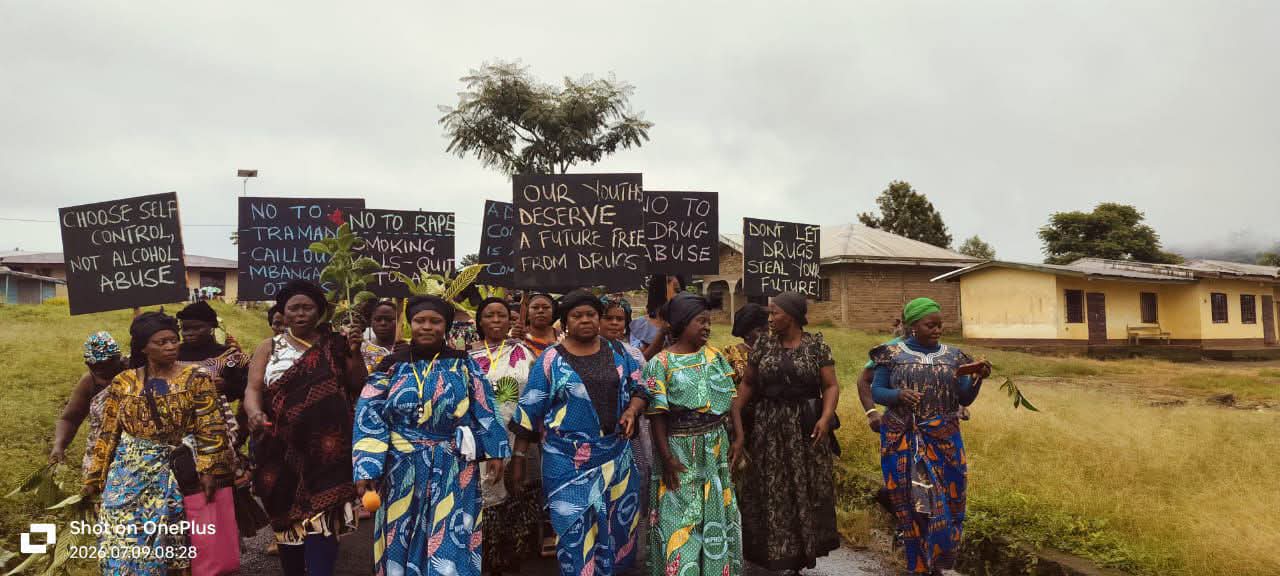
A powerful wave of grassroots resistance is sweeping across Cameroon as grandmothers, mothers, and young girls unite to combat a surging crisis of youth drug abuse and Gender-Based Violence – GBV.
Recent mass demonstrations in the Northwest and Southwest regions, particularly in towns like Bangem and Tombel, highlight a breaking point for local communities. Frustrated by rising delinquency and legal inertia, these women are leveraging both peaceful advocacy and traditional social mechanisms to demand immediate systemic change and protect the next generation.
On Thursday, July 9, 2026, this movement culminated in a massive mobilization of over 1,000 women in the Bangem Subdivision for a peaceful advocacy walk organized by the Subdivisional Delegation of Women’s Empowerment and the Family – DAPROFF.
Led by Subdivisional Delegate Mrs. Epumangando Synthia Epede’Bih alongside prominent female judicial, regional, and municipal leaders, the demonstrators marched through Bangem Town clad in traditional Kabba attire and black headscarves. The march carried an agonizing urgency, serving as a platform for mothers to tearfully condemn the horrific rape of a three-year-old child just two days prior, demanding stronger protective legal nets for vulnerable minors.
The protests across these subdivisions have been marked by deep cultural and emotional expressions of grief and collective resistance. In Bangem and Tombel, mothers thronged the streets holding traditional peace plants, wailing over the destruction of their families, and invoking traditional rituals to curse drug traffickers and unyielding youth.
Similar scenes have unfolded in Mamfe and Manyu Divisions, where women in communities like Egbekaw and Mbeme wore black attire and poured traditional libations, signaling that the community’s patience with illicit drug networks has completely run out.
Local data from the Ministry of Health and the National Drug Control Committee underscore the terrifying scale of the narcotics epidemic facing the country. More than 15% of young Cameroonians are identified as active drug users, with some hard-hit areas reporting that up to 60% to 70% of youths aged 12 to 15 are involved in substance consumption.
The crisis involves heavily addictive substances such as cannabis (banga), tramadol, and dangerous synthetic mixtures known locally as “cailloux” (crystal meth). This epidemic has been severely exacerbated by the ongoing armed conflicts in the Anglophone regions, which have facilitated illicit trafficking and the normalization of narcotics among vulnerable youth.
In response to these threats, the mobilized women have increasingly turned to direct civic action to reclaim their neighborhoods from criminal elements. In Kumba, hundreds of mothers across three subdivisions marched directly against local drug syndicates, physically dismantling thatched structures used as drug dens before submitting formal grievances to administrative authorities.
Meanwhile, in Tiko and Mutengene, widespread protests by mothers regarding drug trafficking and corresponding local insecurity successfully pushed the Divisional Officer to enforce a strict municipal ban on specific energy drinks frequently mixed with illicit substances.
Beyond direct street action, the broader movement is transitioning toward long-term civic education and institutional reform to safeguard Cameroonian households. Activists and administrative bodies in urban centers like Yaounde VI are hosting specialized seminars to formulate comprehensive civic action plans, boosting sexuality and anti-substance education.
Concurrently, local NGOs and youth foundations have launched multi-day sensitization campaigns in secondary schools and colleges, aiming to educate students on the perils of addiction and steer them toward positive social alternatives.