Forget “Domestic Science sections” or theoretical training on paper. With the official launch of its Vocational Training Center – CFM, Ébebda is preparing to inject an army of highly qualified technicians into the national economic fabric, signaling a major economic shift.
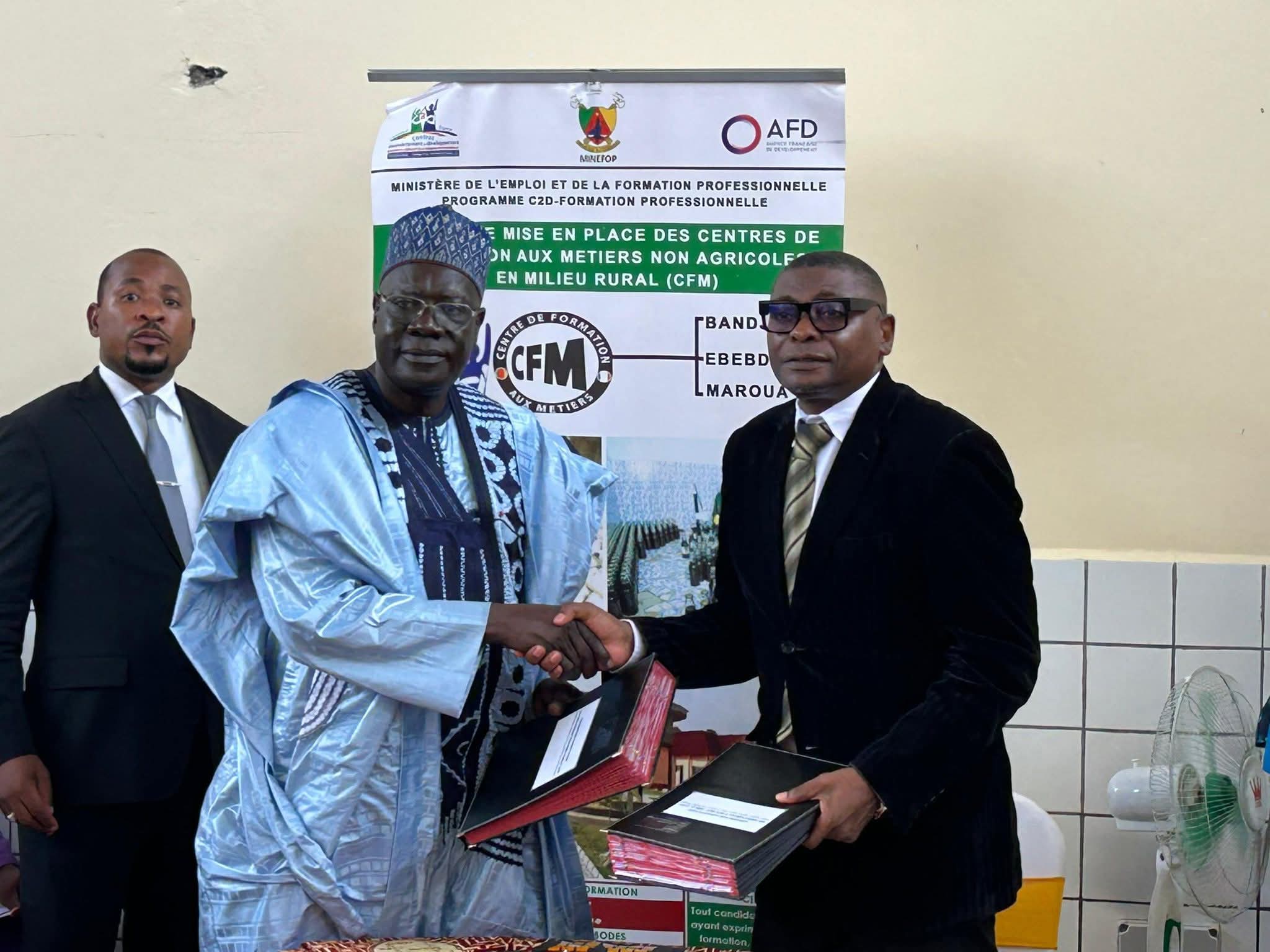
On June 16, 2026, the signing of the CFM’s Constitutive Convention, under the direct patronage of the Minister of Employment and Vocational Training, H.E. Mr. Mounouna Foutsou, unlocked a massive growth lever for the Centre region and beyond. This initiative aims to directly challenge the informal sector in Cameroon, where nearly 90% of the active population survives without market-adapted skills. Funded by the national C2D-FP program to the tune of 25 billion FCFA, this technological hub is built for immediate economic impact rather than just delivering paper diplomas.
Geographically, Ébebda occupies a strategic position as a “bridge city” and crossroads on the major Yaoundé-Bafoussam highway (National Road No. 4). Every day, tons of raw agricultural wealth—including fruits, corn, livestock, and fish from the Sanaga River—transit through the town. Historically, these riches left the area raw, perished along the way, or were sold at low prices due to a lack of local processing facilities.
Starting in October 2026, the CFM will transform this transit point into a true agro-industrial production hub. Local corn will be converted into high-quality silage and livestock feed, regional fruits will become pasteurized juices, and meats will be processed and packaged according to strict quality assurance standards.
This initiative is driving an entrepreneurial wave, backed by a pilot phase that yielded an impressive 70% self-employment rate among learners. The secret to this success lies in a radical educational formula: 70% practical training and only 30% theory. Working in small, tightly supervised micro-cohorts of 12 students, the 150 learners of the 2026–2027 academic year will experience total technical immersion. The two-hectare facility features an on-site exhibition and sales showroom, allowing students to master not only the art of industrial production but also commercial sales and business management. By adding value locally, the center ensures that the wealth generated in the Sanaga and Lekié regions stays within the community.
Another pillar of this model is its governance as a Public Interest Group – GIP, a public-private partnership where the State shares management with three founding members from the private productive sector. This collaborative approach ensures that training programs are completely aligned with market needs, as business owners directly dictate the skills they require. Advanced courses are taught by active professionals, and a work-study format integrates students directly into companies. This close connection between the classroom and industry effectively bridges the gap to employment, leaving students well-positioned for recruitment before they even graduate.
With construction at a 76.58% completion rate and state-of-the-art educational machinery scheduled to arrive in August, Ébebda is on track for an October launch. This project serves as a model for local development by transforming rural youth into a technical elite. It demonstrates that when agricultural potential is paired with targeted expertise, it becomes a powerful source of sustainable employment.
The grand takeoff this October will mark a turning point, proving how local processing can revitalize rural economies and strengthen the “Made in Cameroon” brand.