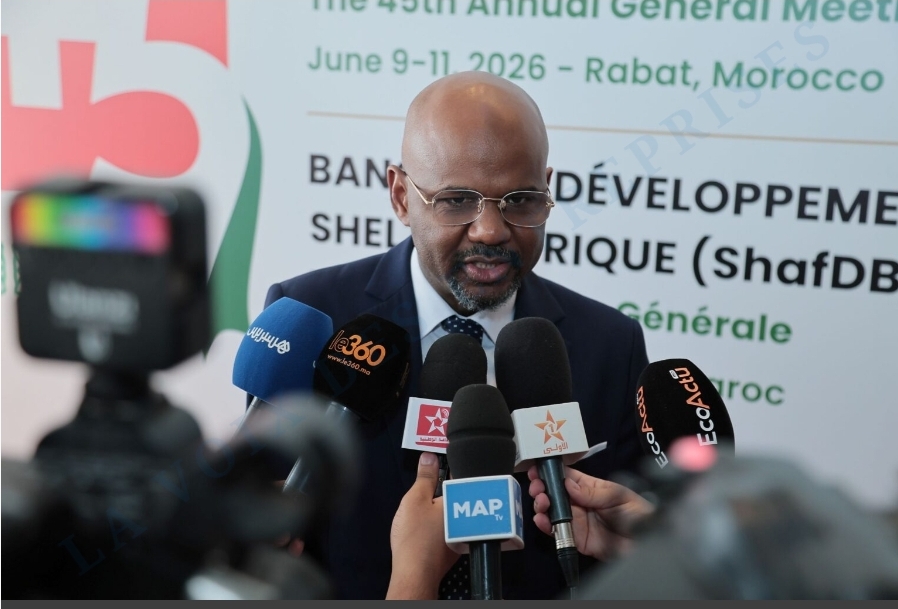
Meeting in Rabat for their 45th Annual General Meeting, shareholders of the Shelter Afrique Development Bank – ShafDB have officially approved a major institutional evolution. The transformation is marked by the unveiling of a new visual identity and a strategic repositioning as a multilateral development bank.
Far from a mere cosmetic change, this shift reflects a calculated commitment to significantly boosting financing capacities for housing and urban infrastructure across an African continent currently grappling with unprecedented, rapid urbanization.
This strategic turnaround comes at a critical time, as Africa faces a massive structural deficit of over 53 million housing units, with total sector financing needs estimated at a staggering $1.3 trillion. Compounding this challenge, the continent’s urban population is projected to double by the year 2050. This demographic explosion is drastically intensifying pressure on basic infrastructure, including transportation, energy, water, utilities, and affordable housing.
To confront these compounding pressures, ShafDB’s leadership is shifting its focus from traditional institutional logic toward a strict, impact-driven framework. The bank’s renewed mandate centers on structuring complex financing mechanisms capable of supporting affordable housing developments, building climate-resilient cities, and deploying sustainable infrastructure. Beyond expanding infrastructure, this approach is designed to act as an economic catalyst that actively generates regional growth and local employment.
This institutional evolution aligns with a broader reshaping of development finance across Africa, where tight state budgetary constraints are forcing multilateral institutions to step up as vital intermediaries between private capital, international investors, and urban demands. Leveraging a robust institutional foundation of 44 member states alongside powerful partners like the African Development Bank and Africa Re, ShafDB is uniquely positioned to scale its operations. This influx of capital is expected to create a substantial economic windfall for the private sector—particularly in construction, engineering, building materials, and financial services—turning housing into a primary economic driver that stimulates various industrial value chains.
The impacts of this restructuring will be felt acutely in regions like Central Africa, where a chronic deficit in urban financing has historically hindered city modernization and economic competitiveness. In Cameroon, for instance, rapid urban growth concentrated around major hubs like Douala, Yaoundé, and Kribi has left local authorities, banks, and real estate developers facing a demand that far outstrips existing financial capacities.
By providing access to structured, long-term financing mechanisms, ShafDB’s new model aims to bridge these regional gaps, proving that the battle for Africa’s economic transformation will ultimately be won or lost within its rapidly growing cities.